
Small, airy buds in late flower trace back to one of seven causes. Most are fixable mid-grow. Some can still be partially addressed even in the final weeks before harvest.
Here's how to diagnose each one.
1. Light intensity is too low
This is the most common cause, and it's frequently underestimated. Growing a healthy plant through veg doesn't take the same light intensity as filling out dense flowers. Most home growers have enough light to get through vegetative growth but not enough to hit the PPFD their buds need in mid-to-late flower.
What you're looking for: plants that stretched significantly in early flower, thin or spindly bud sites that don't stack sideways, flowers that feel almost feathery when squeezed.
What the canopy needs in mid-to-late flower: 800 to 1,200 μmol·m⁻²·s⁻¹ PPFD at ambient CO₂. Drop below 600 and you're leaving significant density on the table.
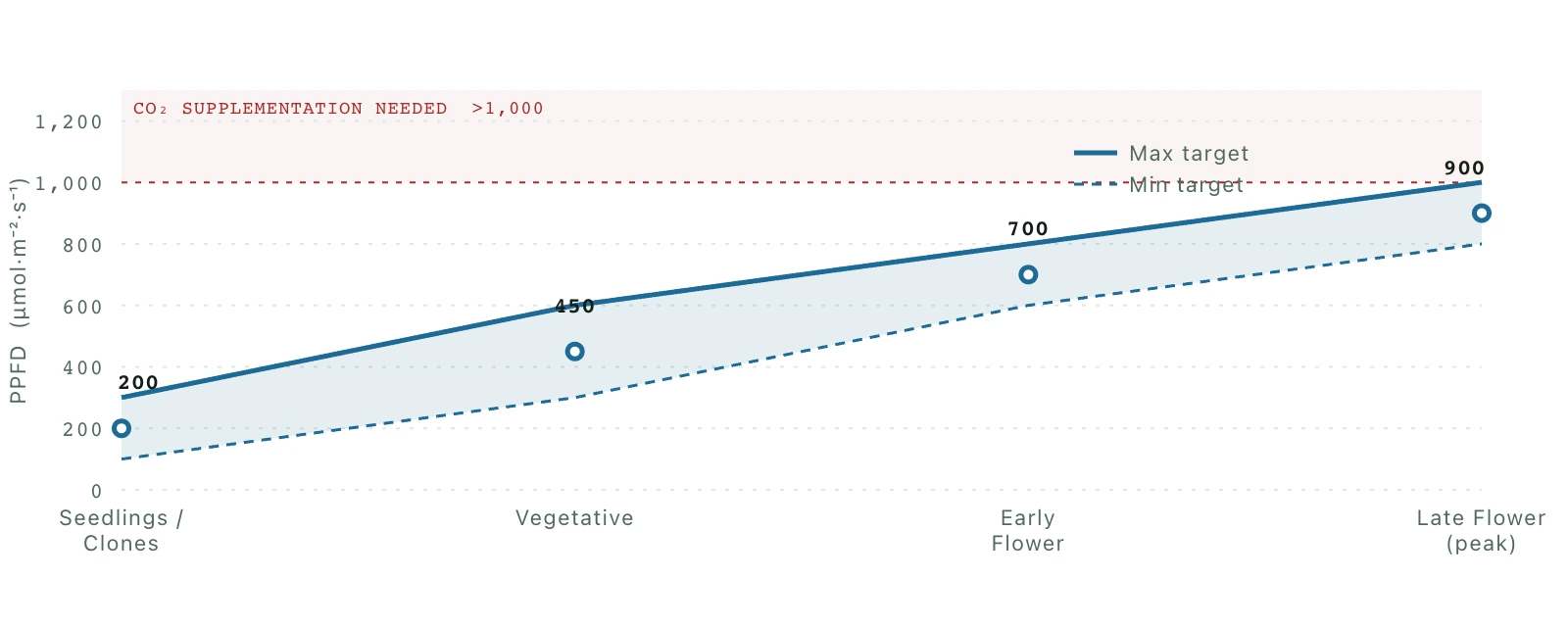
Fix: Measure PPFD at canopy level with a PAR meter, not at the fixture. Adjust hanging distance first. If you're already at the manufacturer's minimum distance, more wattage or a better fixture is the only real path forward.
For a full breakdown of spectrum targets and PPFD by stage, see our grow lights guide for cannabis.
2. Phosphorus or potassium is too low in flower
Phosphorus kicks off flowering. Potassium is what makes buds actually fill out. It drives sugar transport from leaves into developing flowers, increases cell turgor pressure, and contributes directly to the density and dry weight you get at harvest.
If P or K drops off in mid-to-late flower, buds stall. They form. They just don't swell.
What you're looking for: buds that developed normally in early flower but stopped gaining volume around weeks 4 to 5, purple tones in leaves or stems (can indicate K deficiency), slow overall development despite decent light and temps.
Fix by nutrient line:
Classic 3-Part (Micro + Grow + Bloom): By week 2 of flower, you should be fully shifted to Bloom-dominant ratios. If you're still running Grow in any significant amount, that's likely contributing. Adding Bud Booster (0-1-3) from mid-flower through the final week before flush supplies additional late-stage PK along with L-amino acids from hydrolyzed whey protein, including L-tryptophan as an auxin precursor that signals continued flower development.
Bonnie & Clyde: Clyde (3-6-5) is your bloom formula. If you're still running any Bonnie in mid-to-late flower, stop. Full switch to Clyde at transition, then layer in Bud Booster from mid-flower onward.
PuurOrganics: Ramp PuurPhos (0-12-0) and PuurK (0-0-15) starting at transition. Organic systems respond more slowly than salt-based ones, so start the ramp a week earlier than you think you need to.
3. Too much nitrogen in flower
Nitrogen drives growth. In veg, that's exactly what you want. In flower, excess N tells the plant to keep building leaves and stems instead of channeling energy into flower production.
Plants carrying too much nitrogen in flower often look unusually dark green late into the cycle. Their buds stay leafy and loose rather than stacking and consolidating. You'll sometimes see foxtailing: single new calyxes forming on top of existing buds instead of the bud swelling outward as a mass.
What you're looking for: deep green leaves that stay dark in weeks 6 and 7, slow bud stacking, flowers with more leaf material than calyx development.
Fix: Cut nitrogen at transition. For Classic growers, drop or eliminate Grow and shift fully to Bloom (0-5-3). For Bonnie & Clyde growers, switching to Clyde at transition handles this automatically since Clyde's nitrogen content (3%) is half of Bonnie's (6%). Most healthy plants show natural N fade in their lower leaves as they move through mid-to-late flower. If leaves are staying deep green at week 6 or 7, nitrogen is likely still too high.
4. Heat at the canopy
Sustained high temperatures during lights-on can disrupt bud development. Research on cannabis flowering at temperatures around 31°C (88°F) day has found reduced cannabinoid concentrations and abnormal inflorescence development. Heat also pushes the plant to transpire excessively and stresses it at the most critical window for filling out flowers.
What you're looking for: loose, leafy buds with poor resin development, leaves cupping upward or showing bleaching at the very top of the canopy, high exhaust effort that still can't hold temps in range.
Fix: Measure temperature at the canopy, not in the middle of the room. A handheld thermometer held at canopy height is enough. Target 24 to 26°C (75 to 79°F) during lights-on, 20 to 22°C (68 to 72°F) during lights-off in mid-to-late flower. If you're consistently over 28°C at the canopy: raise the light, increase exhaust, add a dehumidifier (which also cools), or defoliate the top layer to reduce heat buildup in the dense canopy.
5. Root problems or overwatering
Roots need oxygen. When a growing medium stays saturated too long, oxygen in the root zone drops, beneficial microbes die off, and the plant can't take up nutrients even when they're present in the solution. The result looks like a nutrient deficiency because it functionally is one, even when the feed is dialed in.
What you're looking for: plants that droop after watering and take a long time to perk back up, slow bud development despite decent conditions, a musty smell from the growing medium, or slimy root mass if you can inspect them.
Fix: Water on a wet-and-dry cycle. Let the medium partially dry between feeds. In soil, a full dry-down between waterings is important. In coco you can push more frequent irrigation, but if you're applying soil-level frequency, you're likely starving the roots of oxygen.
If you're in a pot that's too small for the plant, there's no clean fix mid-flower. Better drainage (elevating pots, adding drainage holes) can help somewhat. Monkey Juice builds a beneficial microbial community in the root zone that helps outcompete the pathogens responsible for root issues. Starting it in veg sets that community before it's needed in flower.
6. Harvesting too early
A lot of "airy buds" were actually buds that got cut 1 to 2 weeks too soon. Cannabis flowers do most of their swelling in the final 2 to 3 weeks before harvest. Cut early and you get smaller, lighter flowers that feel underdeveloped because they are.
What to look for: mostly clear trichomes (too early), or milky white trichomes with few or no amber ones (approaching ripe but not there). At peak harvest, most trichomes are milky, with roughly 10 to 30% amber depending on how heavy an effect you prefer. Mostly amber means THC is degrading and you've gone past peak.
Important: Check trichomes on the calyx, not the sugar leaves. Leaf trichomes ripen faster and will read ahead of the actual buds. A 60x jeweler's loupe or a small digital trichome scope gives you a clear enough view.
If you're seeing mostly clear or milky trichomes without amber, let it go at least another week.
7. Genetics
Some strains just produce airier flowers. Sativa-dominant varieties, hazes, and equatorial genetics often grow longer, finger-like buds with more space between calyxes. That's the plant expressing its genetics, not a deficiency.
If you've checked light, nutrients, temps, roots, and timing, and the plant otherwise looks healthy, you're likely dealing with genetics that produce this structure.
There isn't a fix for the current grow. Sativa-dominant buds frequently have more complex terpene profiles than dense indica nugs, so the trade-off is real. If density is a priority next cycle, choose an indica-dominant or hybrid with a reputation for tight calyx stacking.
One thing that doesn't cause airy buds: high humidity
High humidity during flower is a bud rot risk. It's not an airy bud cause. These are different problems entirely.
Botrytis cinerea (grey mold, bud rot) causes buds to turn brown, collapse, and go mushy from the inside. Airy buds are a structural development issue that forms over weeks. If you're seeing thin, loose flowers, look at light, nutrients, timing, and temp. If you're seeing browning or soft spots inside dense flowers, that's bud rot.
The threshold for cannabis-specific bud rot in a dense canopy is above 70% RH at the canopy microclimate during mid-to-late flower. Dense buds trap moisture inside them, so your room RH reading and your bud interior RH are not the same number. Airflow through the canopy matters as much as what the hygrometer on the wall says. For the full breakdown of what causes it, the early warning sign most growers miss, and how to stop it, see our complete guide to bud rot in cannabis.
The Cronk protocol for denser flowers
If you're running Cronk nutrients and want to set up the strongest possible foundation for dense late-flower development, here's the timing structure by line. For specific dosages by grow medium, see the Cronk feed charts.
Timing | Classic 3-Part | Bonnie & Clyde | PuurOrganics |
|---|---|---|---|
Transition (weeks 1 to 2 of flower) | Drop Grow, shift to Bloom-dominant ratios. Keep Micro throughout. | Stop Bonnie. Full switch to Clyde (3-6-5). | Start ramping PuurPhos and PuurK. Maintain PuurNitro at a moderate level. |
Mid-flower (weeks 3 to 6) | Add Bud Booster. Bloom continues. Micro continues. | Add Bud Booster. Clyde continues. | Continue PuurPhos and PuurK ramp. Add PuurBalance for micronutrients. |
Late flower (weeks 7 through final week before flush) | Continue Bud Booster. Add Sticky Bandit for terpene and resin support. | Continue Bud Booster and Sticky Bandit. Clyde continues. | Maintain PuurPhos and PuurK. Add Sticky Bandit. Taper PuurNitro toward zero. |
Final 1 to 2 weeks | Flush or plain water depending on your finish method. | Flush or plain water. | PuurOrganics is compatible with living-soil no-flush finishes. Water only or light feed. |
Armadillo Armour (monosilicic acid) is worth running from early veg through late flower. Silicon builds cell wall strength throughout the plant, including developing flower structures. Starting it before flower gives the plant maximum time to incorporate it into new tissue.
Common questions
Can I fix airy buds at week 6 of flower?
It depends on the cause. Light problems can't be meaningfully fixed this late in the grow. If it's a nutrient ratio issue (low P or K), adjusting the feed now can still improve the final 2 to 3 weeks of swell. If it's genetics, harvest at the right time and choose a denser strain next cycle.
Do airy buds have less THC?
Not necessarily. Trichome density and potency aren't the same thing as physical bud density. A sativa with loose, airy flowers can be just as potent as a compact indica. That said, buds that were underdeveloped due to light deficiency or early harvest do typically have lower potency than they would have had if left to finish properly.
Does flushing too early cause airy buds?
Yes. Starting a 3 to 4 week flush starves the plant of phosphorus and potassium during the peak swell period. Most growers flush for 1 to 2 weeks. If you're flushing long and the buds aren't filling, stop the flush and resume feeding.
What's the difference between airy buds and foxtailing?
Foxtailing is when new single calyxes form on top of an existing bud, creating a tail shape instead of the bud swelling outward as a mass. It can happen from heat stress (lights too close, canopy too hot) or from the genetics of certain sativa-dominant cultivars. Foxtailing creates the appearance of bud growth while actual density lags. Airy buds are more uniform in structure: they form, they just don't fill in.