
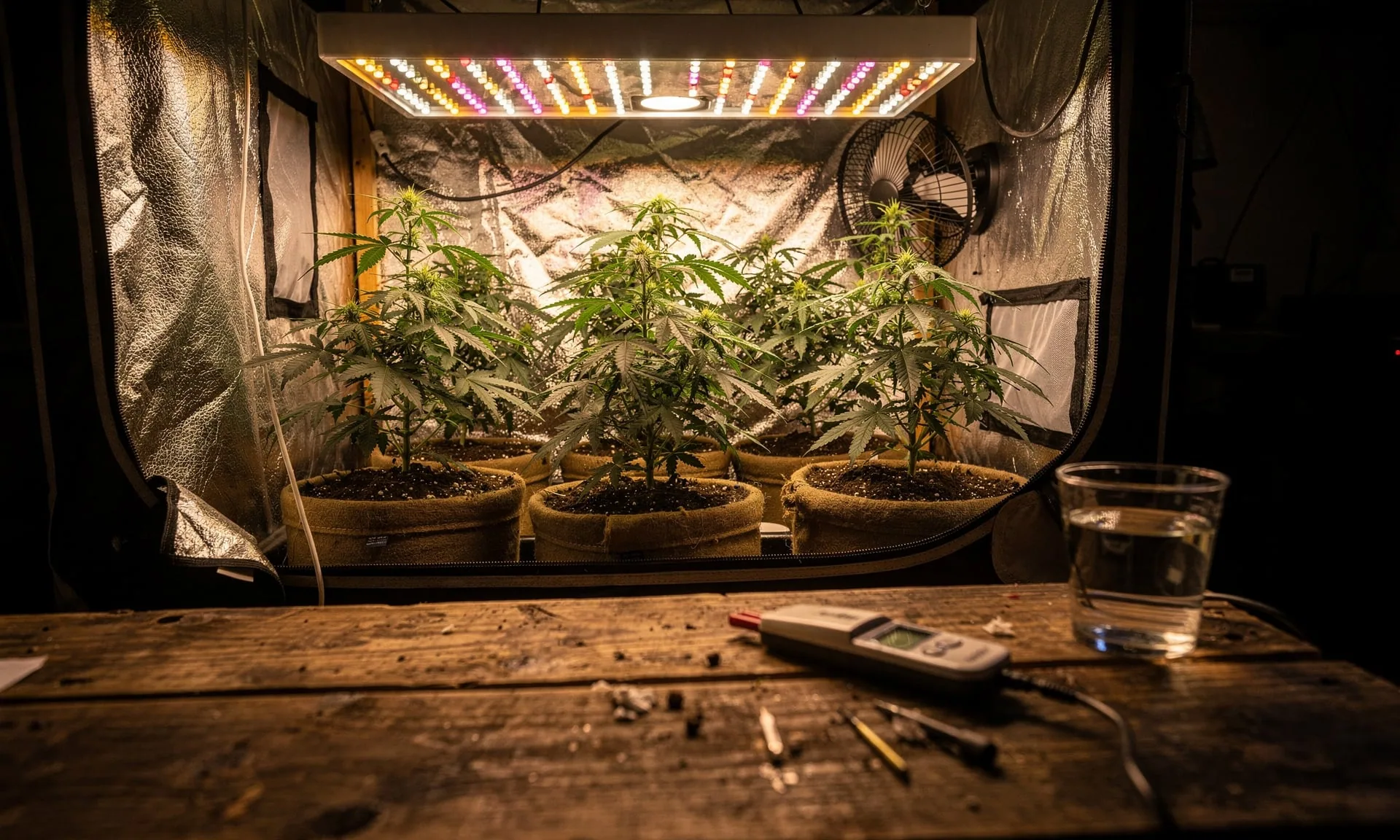
How to Feed Cannabis in Coco Coir: A Complete Guide
Coco coir is one of the most popular growing mediums for cannabis, and for good reason. It combines the forgiveness of soil with the speed of hydroponics. But coco has unique characteristics that require a different feeding approach than soil or traditional hydro.
This guide covers everything you need to know about feeding cannabis in coco coir—backed by peer-reviewed research from studies including Bevan et al. (2021), Saloner & Bernstein (2020-2021), and NC State Cannabis Research.
What Makes Coco Different from Soil
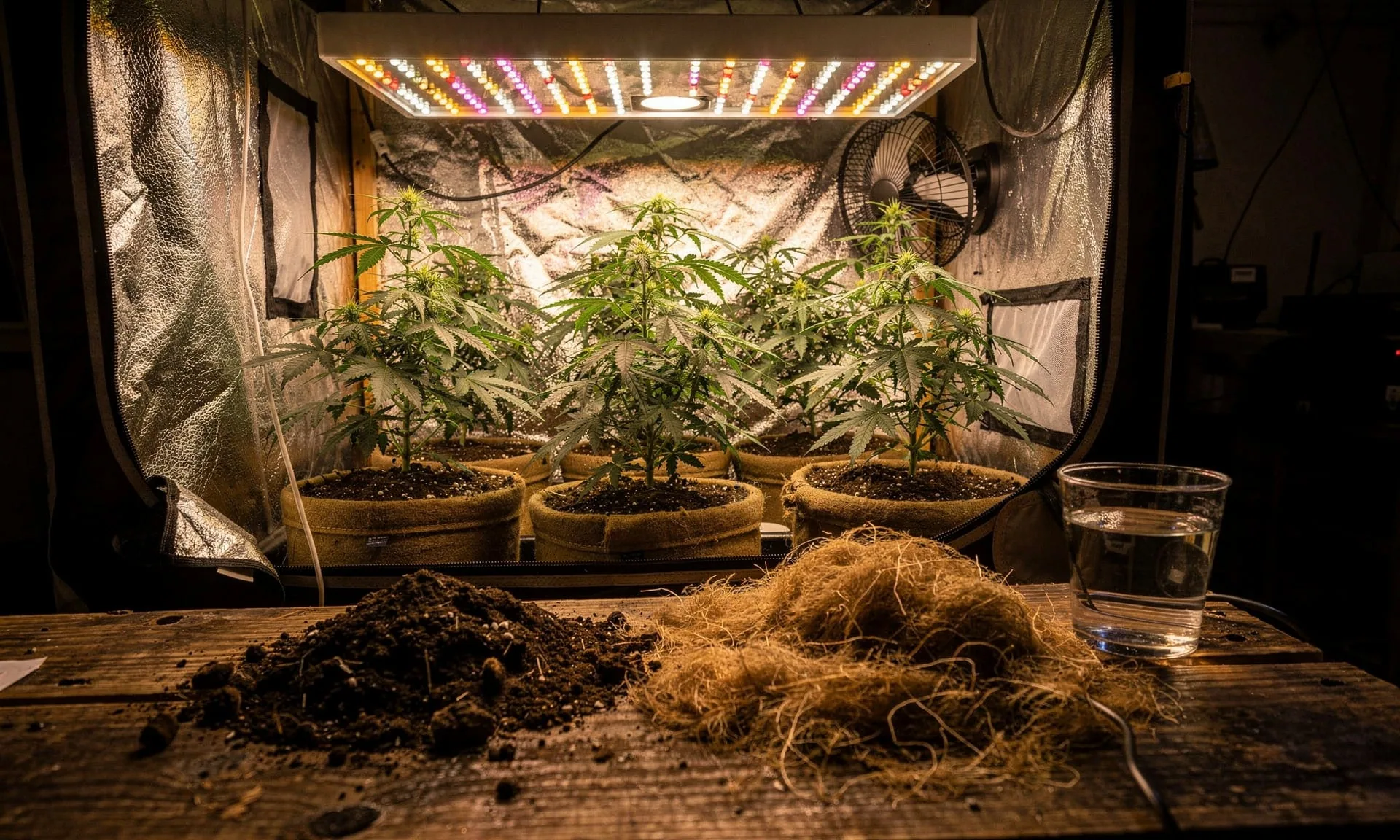
Coco coir is made from processed coconut husks. Unlike soil, it contains almost no nutrients on its own, which means you're in full control of what your plants eat.
Here's what sets coco apart:
- Inert medium — Coco provides structure but no nutrition. You supply 100% of the nutrients.
- Excellent drainage and aeration — Roots get more oxygen than in soil, which speeds up growth.
- High cation exchange capacity (CEC) — Coco naturally binds to calcium and magnesium ions, which can cause deficiencies if you don't compensate.
- Faster dry-back — Coco dries out quicker than soil, so you'll water more frequently.
Because of these properties, coco is sometimes called a "hydroponic medium in a pot." You get the physical benefits of a container grow with the responsiveness of a hydro system.
The Calcium and Magnesium Factor
This is the most important thing to understand about coco: it naturally binds to calcium and magnesium ions.
Fresh coco coir has a high cation exchange capacity (CEC), meaning it holds onto Ca²⁺ and Mg²⁺ ions from your nutrient solution. Even "buffered" coco (pre-treated with calcium) will continue to pull these elements, especially in the first few weeks of use.
Research context: According to Saloner & Bernstein's cannabis nutrition studies, optimal calcium levels are 100-110 ppm and magnesium should be 35-70 ppm throughout the grow cycle. In coco, you'll need to add supplemental CalMag to maintain these levels.
What This Means for You
- You need to add a CalMag supplement to nearly every feeding in coco.
- Without it, you'll see deficiency symptoms: yellowing between leaf veins (Mg), brown spots and curled new growth (Ca).
- LED grow lights increase calcium and magnesium demand even further.
Research-Backed CalMag Rates for Coco
| Water Type | Starting EC | CalMag (mL/gal) | Target Ca (ppm) | Target Mg (ppm) |
|---|---|---|---|---|
| RO or soft water | Under 0.1 EC | 4–5 mL/gal | 100-110 | 45-55 |
| Tap water (moderate) | 0.2-0.4 EC | 2–3 mL/gal | 100-110 | 45-55 |
| Hard tap water | Over 0.4 EC | 0–2 mL/gal | Check levels | Check levels |
Source: Targets based on Saloner & Bernstein (2020-2021) optimal Ca:Mg ratio of 2:1 to 3:1
If you're using RO water, CalMag isn't optional—it's essential.

CalMag 2-0-0 — Synthetic CalMag supplement, fast-acting, compatible with all Cronk lines
PuurCalMag — Organic CalMag from limestone and deep-earth brine, OMRI-listed
Both deliver approximately 9.7 ppm Ca and 3.6 ppm Mg per mL/gallon
pH Range for Coco (Research-Backed)
Coco performs best in a slightly acidic range, similar to hydroponics but a bit more forgiving.
Target pH: 5.8–6.3
According to the peer-reviewed research compiled from Bevan et al. and NC State studies, the optimal pH range shifts slightly through the grow cycle:
| Growth Stage | pH Low | pH High | Sweet Spot |
|---|---|---|---|
| Seedling | 5.8 | 6.2 | 5.9–6.0 |
| Vegetative | 5.8 | 6.5 | 5.9–6.1 |
| Transition | 5.8 | 6.5 | 6.0–6.2 |
| Flower (Early-Mid) | 5.8 | 6.3 | 5.9–6.1 |
| Flower (Late) | 5.8 | 6.0 | 5.8–5.9 |
| Flush | 6.0 | 6.5 | 6.0–6.2 |
Source: Bevan et al. (2021), NC State Cannabis Research
Unlike soil, coco doesn't buffer pH significantly. If your input pH is off, your plants will feel it quickly. Always pH your nutrient solution after mixing all components.
Pro tip: Let your pH drift slightly within the range over multiple feedings. For example, feed at 5.8 one day and 6.2 the next. This ensures all nutrients get their moment of peak availability—different elements absorb best at different pH points.
EC and PPM Targets by Growth Stage
These targets are based on peer-reviewed cannabis nutrition research, specifically the work of Bevan et al. (2021) and Caplan et al. (2017) on EC management in controlled environment cannabis production.
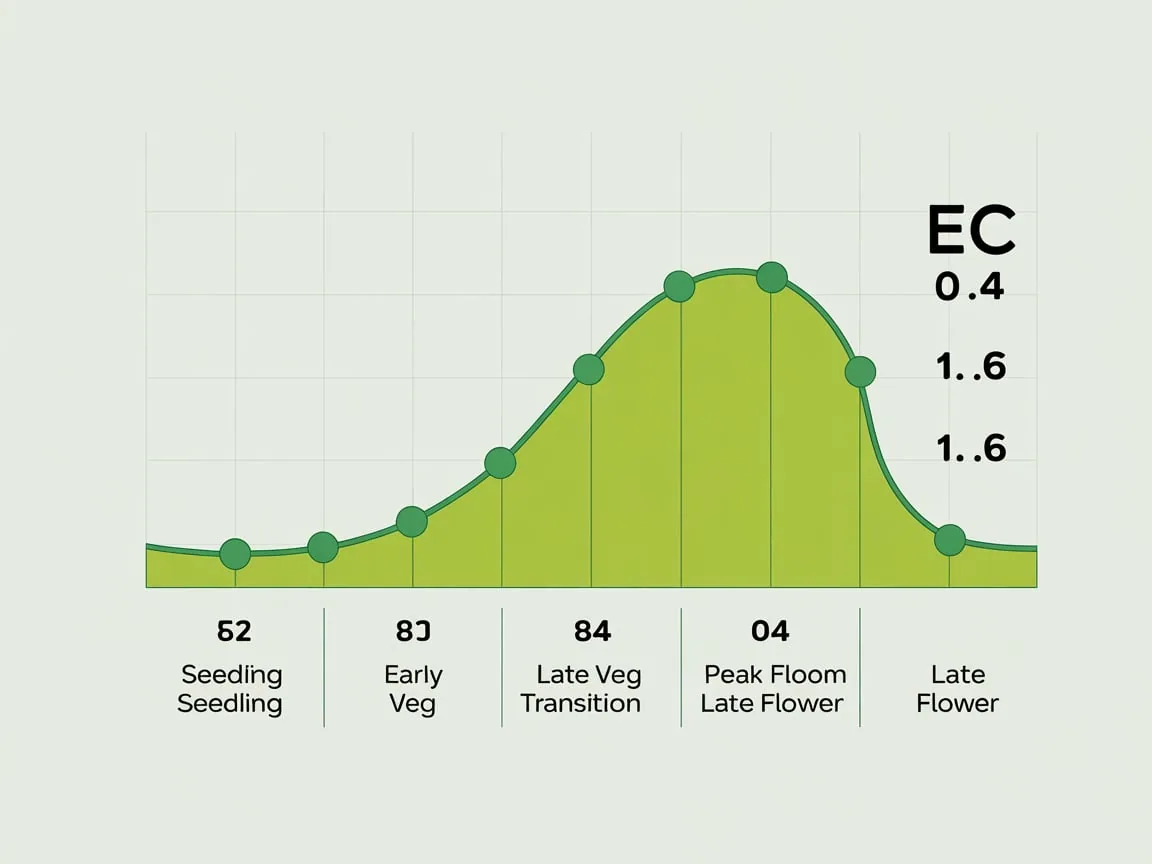
| Growth Stage | Week | EC Range | PPM (500 scale) | N Target (ppm) | Notes |
|---|---|---|---|---|---|
| Seedling | 1-2 | 0.3–0.4 | 150–200 | 50-80 | Gentle start, root development |
| Early Veg | 3-4 | 0.6–0.8 | 300–400 | 120-150 | Canopy expansion begins |
| Late Veg | 5-8 | 1.0–1.2 | 500–600 | 180-200 | Peak N uptake phase |
| Transition | 9-10 | 1.3–1.5 | 650–750 | 190-194 | Light flip, P/K ramp |
| Early Flower (F1-F2) | F1-F2 | 1.5–1.6 | 750–800 | 194 | Research optimal N* |
| Mid Flower (F3-F5) | F3-F5 | 1.4–1.6 | 700–800 | 150-180 | Begin N reduction |
| Peak Flower (F6-F7) | F6-F7 | 1.2–1.3 | 600–650 | 100-130 | Low N boosts THC |
| Late Flower (F8-F10) | F8-F10 | 0.5–1.0 | 250–500 | 25-75 | Controlled senescence |
| Flush | F11-F12 | 0.0–0.1 | 0–50 | 0 | Plain water only |
*Bevan et al. (2021) found optimal nitrogen at 194 ppm and phosphorus at 59 ppm for maximum flower yield. N showed a quadratic response—too much or too little reduced yields.
Important: These are research-based starting points. Watch your plants and adjust based on response. Leaf tip burn means you're pushing too hard; pale new growth means you can increase.
Critical Nutrient Ratios
Research from Shiponi & Bernstein (2021) established that maintaining proper nutrient ratios is as important as hitting specific ppm targets.
| Ratio | Optimal Value | Stage | Why It Matters |
|---|---|---|---|
| K : Ca : Mg | 4 : 2 : 1 | All Stages | Cation balance—critical for nutrient uptake |
| N : K (Veg) | 1.1 : 1 | Vegetative | Slightly higher N for leaf development |
| N : K (Flower) | 1 : 1.5 | Flowering | Higher K supports flower development |
| Ca : Mg | 2:1 to 3:1 | All Stages | Optimal uptake balance |
| Ca : B | 100 : 1 | All Stages | Boron enhances calcium mobility |
| Fe : Mn | 2:1 to 3:1 | All Stages | Balance prevents antagonism |
| NO₃ : NH₄ | 75-90% : 10-25% | All Stages | Nitrate dominant prevents ammonium toxicity |
Source: Shiponi & Bernstein (2021), Saloner & Bernstein (2020-2021)
The K:Ca:Mg ratio of 4:2:1 is particularly important in coco because the medium's high CEC can throw off cation balance if you're not compensating with CalMag.
Watering Frequency in Coco
One of the biggest mistakes new coco growers make is treating it like soil. In coco, more frequent watering equals faster growth.
Research from Bugbee (2004) on recirculating hydroponic systems confirms that maintaining consistent moisture in inert media optimizes nutrient uptake and growth rates.
Guidelines by Growth Stage
- Seedlings: Water every 2–3 days, or when the top inch feels dry.
- Vegetative plants: Water daily or every other day.
- Flowering plants: Water 1–2 times per day, especially in larger pots or warm environments.
The goal is to keep coco consistently moist—not soaking wet, but never bone dry. Coco that dries out completely can become hydrophobic (water-repellent) and create dry pockets in the root zone.
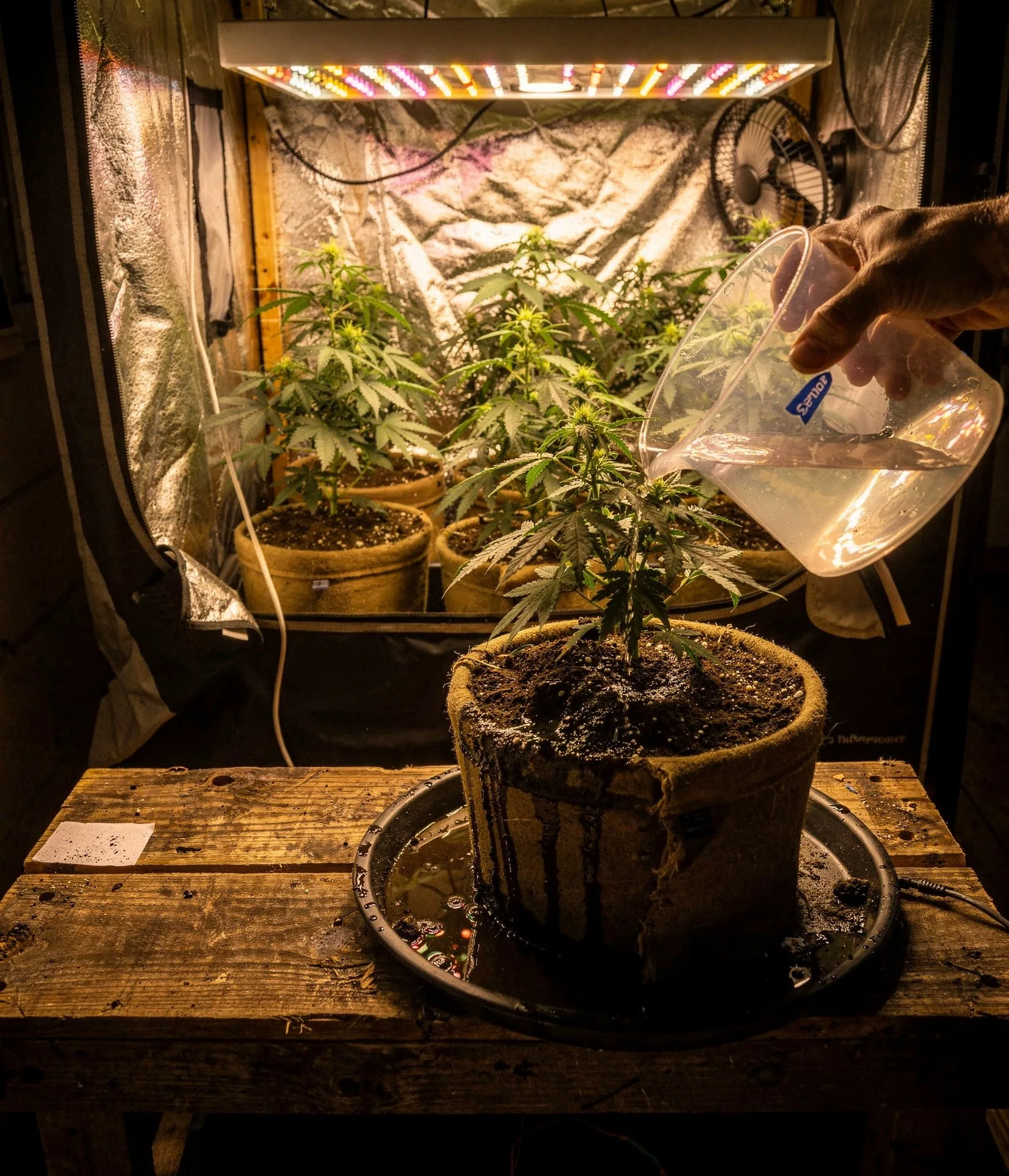
Always water to runoff. Aim for 10–20% runoff to flush out accumulated salts and ensure even saturation throughout the container.
Feed Every Watering (Fertigation)
In coco, the standard practice is to feed with every watering—this is called fertigation.
Unlike soil, where you might alternate between plain water and nutrient water, coco growers typically include nutrients in every watering. The frequent watering flushes out old solution while delivering fresh nutrition.
Exception: Some growers do a plain water flush once a week or every 10 days to reset salt levels. This is optional but can help if you're seeing EC buildup in runoff.
Mixing Order (Critical)
- Start with your base water
- Add silica first (if using—it raises pH significantly)
- Add CalMag (let it mix for 2–5 minutes if using RO water)
- Add base nutrients (Micro first if using a 3-part system)
- Add Grow and/or Bloom
- Add any additives or boosters
- pH adjust last
- Add beneficial bacteria products after pH (to protect live cultures)
1. Armadillo Armour — Silica (add first if using)
2. CalMag 2-0-0 or PuurCalMag — Calcium & Magnesium
3. Micro 5-0-1 — Foundation nutrients (always before Grow/Bloom)
4. Grow 2-1-6 / Bloom 0-5-3 — Stage-specific base
5. Sticky Bandit, Bud Booster — Additives
6. pH adjustment
7. Monkey Juice — Beneficial bacteria (always last)
Signs You're Feeding Correctly
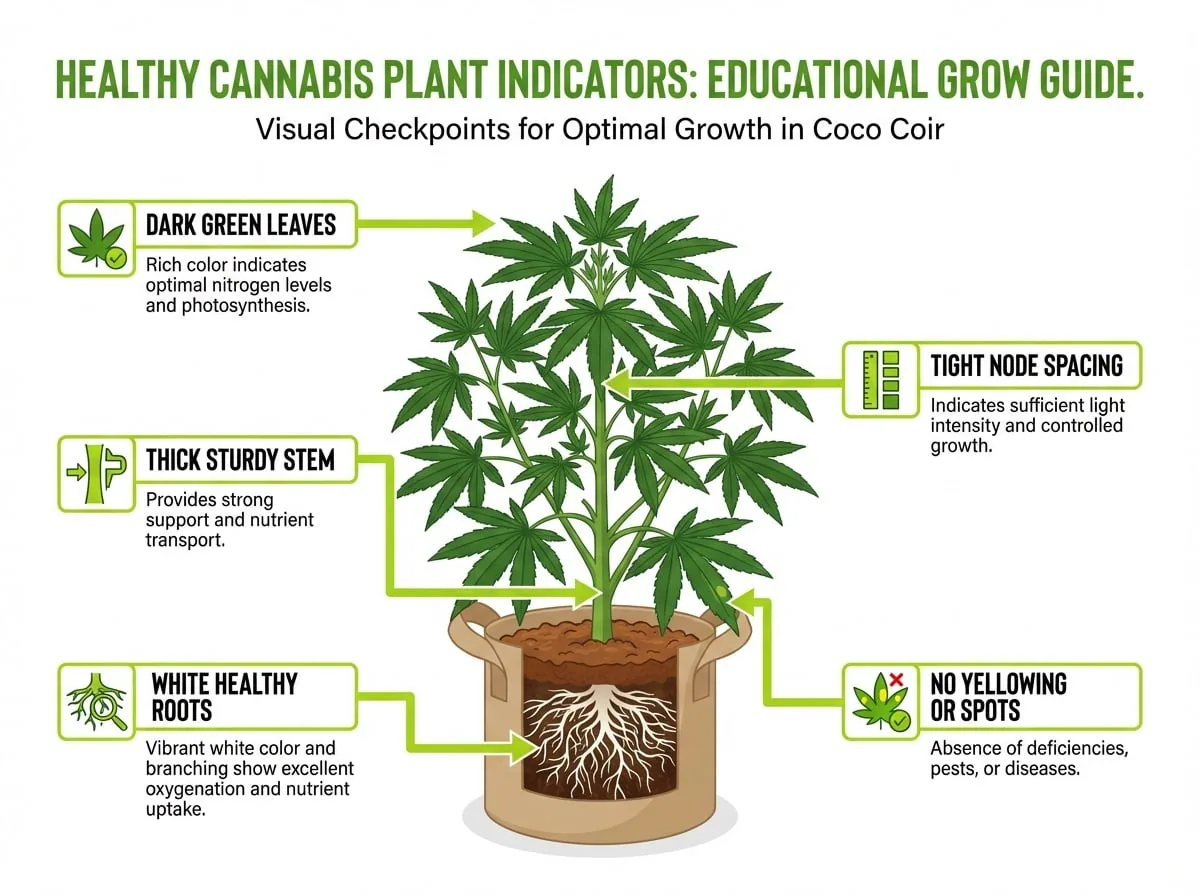
Healthy coco-grown plants show:
- Dark green leaves with no yellowing or spotting
- Strong, sturdy stems that don't need support early in veg
- Vigorous root growth (white, fuzzy roots if you can see them)
- Fast vegetative growth (coco can outpace soil significantly)
- Consistent internode spacing (not stretchy or overly compact)
Common Problems and Fixes
Yellow Leaves Between Veins (Interveinal Chlorosis)
Likely cause: Magnesium deficiency
Research context: Optimal Mg is 35-70 ppm. Deficiency shows as interveinal yellowing, typically on lower/older leaves first.
Fix: Increase CalMag by 1–2 mL/gal. Verify pH is in range—Mg locks out below pH 5.8.
Brown Spots or Leaf Edge Burn
Likely cause: Calcium deficiency or pH out of range
Research context: Optimal Ca is 100-110 ppm. Deficiency shows as brown spots, curled new growth, and weak stems.
Fix: Add more CalMag, ensure pH is 5.8–6.3, and confirm you're watering to runoff to prevent salt lockout.
Dark, Clawed Leaves (Nitrogen Toxicity)
Likely cause: Overfeeding nitrogen
Research context: Bevan et al. found N response is quadratic—both deficiency AND excess reduce yields. Max benefit at 194 ppm during early flower.
Fix: Reduce base nutrients by 20–30%. Flush with pH'd water at 10–20% of normal EC.
Slow Growth Despite Good Conditions
Likely cause: Underwatering or letting coco dry out completely
Fix: Increase watering frequency. In coco, more water (with nutrients) means faster growth. The medium should stay consistently moist.
Salt Buildup (White Crust on Surface)
Likely cause: Insufficient runoff or infrequent watering
Fix: Always water to 10–20% runoff. Consider a plain water flush to reset.
Coco vs. Soil: Key Differences Summary
| Factor | Coco Coir | Soil |
|---|---|---|
| pH Range | 5.8–6.3 | 6.2–6.8 |
| Watering Frequency | Daily or more | Every 2–4 days |
| CalMag Required | Yes, every feeding | Usually not required |
| Nutrient Frequency | Every watering (fertigation) | Every other watering |
| Dry-Back Time | Fast (hours to 1 day) | Slow (2-4 days) |
| Growth Speed | Faster (hydro-like) | Moderate |
| Forgiveness | Less forgiving (responds fast) | More forgiving (buffers errors) |
| Nutrient Control | Full control (inert medium) | Partial (soil provides some) |
Quick Start Checklist for Coco
Before your first feed, make sure you have:
- ☐ Quality coco coir (buffered and rinsed is best)
- ☐ CalMag supplement (essential, not optional)
- ☐ pH meter (accurate to 0.1)
- ☐ EC/PPM meter (to track nutrient strength)
- ☐ Base nutrients (3-part or 2-part system)
- ☐ pH Up and pH Down solutions
Base Nutrients (choose one system):
• Classic 3-Part: Micro 5-0-1 + Grow 2-1-6 + Bloom 0-5-3
• Bonnie & Clyde: Bonnie (veg) + Clyde (flower) — for autoflowers
Essential Supplement:
• CalMag 2-0-0 — Required for coco, especially with RO water or LEDs
Recommended Additives:
• Armadillo Armour — Silicon for stronger stems and stress resistance
• Monkey Juice — Beneficial bacteria for root health
• Bud Booster 0-1-3 — P/K boost during mid-late flower
Research Citations
This guide is based on peer-reviewed cannabis nutrition research:
- Bevan et al. (2021) — Frontiers in Plant Science: Optimal N at 194 ppm, P at 59 ppm for flower yield; nitrogen shows quadratic response
- Saloner & Bernstein (2020-2021) — NCSU/Haifa research: Vegetative targets N 160ppm, P 30ppm, K 175ppm; Ca 110ppm baseline
- Shiponi & Bernstein (2021) — K:Ca:Mg ratio of 4:2:1 optimal for cation balance
- NC State Cannabis Research — Flowering micronutrients: Fe 3-3.5, B 0.875-1.0, Mn 0.5-0.88, Zn 0.05-0.2 ppm
- Caplan et al. (2017) — Frontiers in Plant Science: EC ranges and organic vs synthetic responses
- Cockson et al. (2019) — Micronutrient requirements increase during flowering phase
- Bugbee (2004) — Crop physiology: Nutrient management in recirculating hydroponic systems
- Abad et al. (2002) — Bioresource Technology: Coco coir cation exchange properties
Final Thoughts
Coco coir rewards growers who stay consistent. Feed regularly, maintain proper pH (5.8-6.3), never skip the CalMag, and water to runoff. Do these things, and coco will deliver faster growth and bigger yields than most other mediums.
The learning curve is real, but once you dial it in, you'll understand why so many growers never go back to soil.
Still have questions? Contact our grow support team at [email protected]