
Most deficiency charts start with the nutrient. Start with the plant instead: which leaves are affected, old growth or new, and what color or shape the symptom takes. That one question, old growth or new, splits every deficiency into two groups before you've even looked at color. It's the fastest way to narrow a guess down to two or three real candidates.
Is the Symptom on Old Growth or New Growth?
Nitrogen, phosphorus, potassium, magnesium and molybdenum are mobile inside the plant. When it runs short, it pulls these out of older, lower leaves and relocates them to new growth, which is why deficiencies in these show up on the bottom of the plant first. Chlorine and nickel are mobile too, but this page doesn't cover either one as its own deficiency yet. Calcium, iron, manganese, copper and boron barely move at all once they're deposited, so a shortage in any of these shows up on new growth at the top, right where it's happening. Zinc and sulfur sit between the two groups, but both behave closely enough to the immobile set that they show up on new growth too.
| If the symptom is on | Suspect first |
|---|---|
| Lower, older leaves | Nitrogen, phosphorus, potassium, magnesium, or molybdenum (mobile). Chlorine and nickel are mobile too, not covered on this page |
| Upper, new growth | Calcium, iron, manganese, zinc, boron, copper, or sulfur (immobile or near-immobile) |
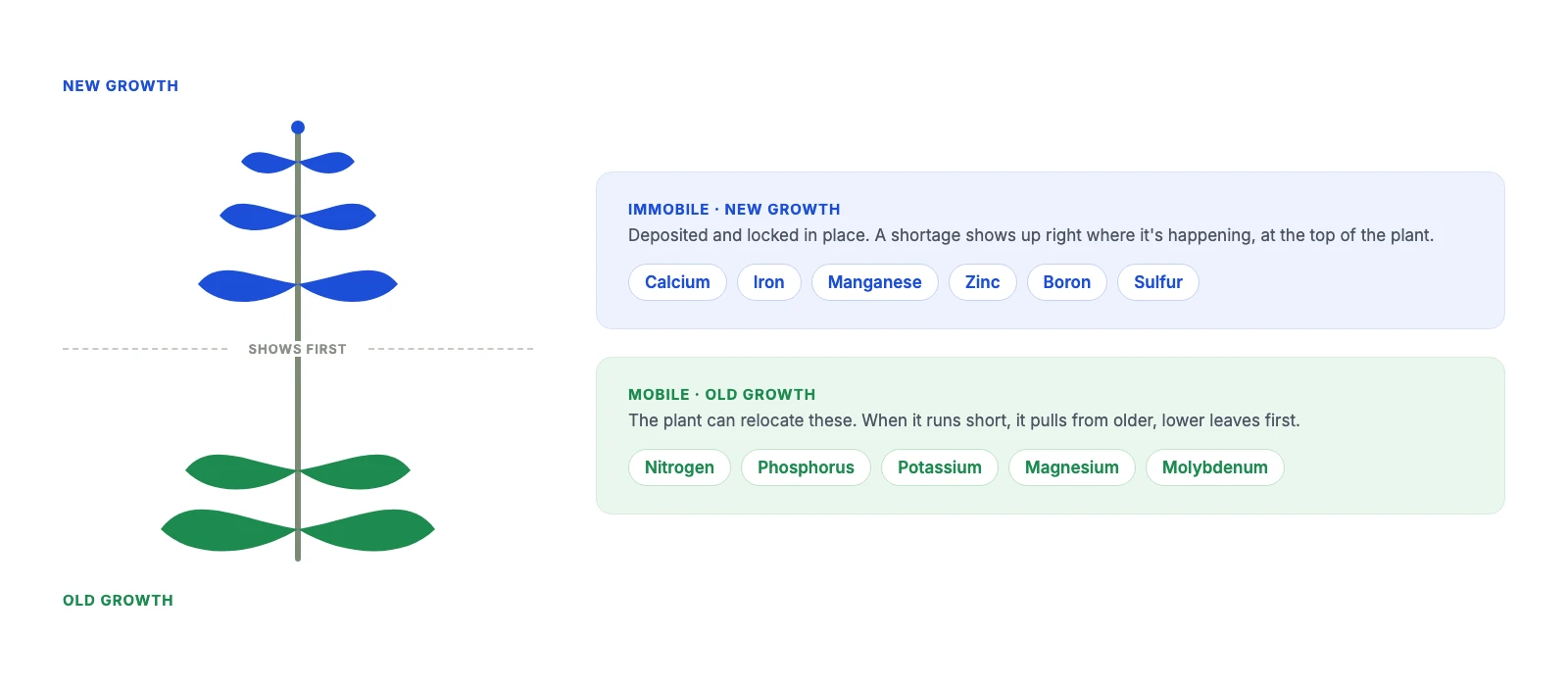
This is how nutrient transport works in every plant, not a rule specific to any one feeding program. But it's the single fastest filter in this whole chart, so it goes first.
The Deficiency Chart
| Nutrient | Where it shows | What it looks like | What to do |
|---|---|---|---|
| Nitrogen (N) | Lower leaves, whole plant in severe cases | Uniform yellowing across the whole leaf, lowest leaves first, and they drop easily when touched. Growth slows | Raise nitrogen through your base feed for the stage you're in. In the last few weeks before harvest, lower-leaf yellowing is normal fade and not a deficiency at all |
| Phosphorus (P) | Lower leaves and stems | Dark blue-green leaves early, purple or red stems and petioles, dark spots that can turn necrotic | Raise phosphorus through a bloom-stage formula. Go up carefully. High phosphorus suppresses zinc and iron uptake, which are two rows down, so overcorrecting here can create the problem you read about next |
| Potassium (K) | Lower leaf edges | Yellowing or browning along the margins and tips first, leaf edges curl and feel dry and crispy, weak stems | Raise potassium through your base feed. In coco, the medium releases potassium of its own early in a grow, so a genuine shortage there is less common than it looks |
| Magnesium (Mg) | Lower leaves | Yellowing between the veins while the veins themselves stay green, starts at leaf edges and moves inward | A calcium and magnesium supplement. Most common in coco, which holds onto magnesium before the plant gets it, and on RO or soft water, which brings none of its own |
| Calcium (Ca) | New growth and stem tips | Distorted or curled new leaves, brown spots that appear almost randomly, weak stems | The same calcium and magnesium supplement. Coco and RO water are again where this actually happens. Note that these products move both elements together, so you can't raise calcium alone with one |
| Iron (Fe) | New growth | Interveinal yellowing on young leaves with normal leaf size and spacing, veins stay green, can bleach nearly white in severe cases | Check pH first. Iron lockout above the target range is a more common cause of these symptoms than a true shortage. If pH is right, iron usually comes from the micronutrient part of a base feed rather than a standalone product |
| Manganese (Mn) | New growth | Interveinal yellowing on young leaves, very similar to iron, but with tan or brown dead spots developing inside the yellow areas | Check pH first, and don't worry about telling it apart from iron. Both lock out for the same reason and both come back with the same fix. If pH is high, bring it into range for your medium and they resolve together. Manganese normally comes from the micronutrient side of a base feed |
| Copper (Cu) | New, expanding leaves | Onset is very late, about nine weeks after copper was withheld in the one controlled cannabis trial available, and the plant usually doesn't look like a copper problem at all before then. Advanced symptoms are new and expanding leaves narrowing at the base and distorting, then developing marginal interveinal chlorosis that spreads into a fine pattern across the whole leaf as it advances, with the margins curling in and downward. An unusual wilting pattern has also been reported. This leaf distortion is what separates copper from iron or manganese, which cause interveinal yellowing but not this narrowing and curling. That same trial reported an earlier stage that looked different from the immobile pattern above: marginal yellowing on lower leaves that intensified and moved inward before the new-growth symptoms appeared. The study's own authors called this presentation unusual for the crop. Treat lower-leaf yellowing as a possible early copper signal, not a rule to diagnose by | Sufficient tissue levels run 5 to 11 mg/kg. Because true onset takes so long, and because the one study that looked closely found an unsettled early stage, don't rule copper out just because you haven't seen the textbook new-growth symptoms yet |
| Zinc (Zn) | New growth, growing tips | Interveinal yellowing plus small, distorted new leaves that cluster or bunch (rosetting), with shortened internode spacing | Check pH first here too. Zinc has a narrow working window, and excess zinc produces the same interveinal yellowing as an iron shortage, so more is not the safe guess. Zinc normally comes from the micronutrient side of a base feed |
| Boron (B) | New growth, growing tips | Burned-looking, stunted or twisted growing tips, thick brittle new leaves, stems that go hollow and crack. Too much boron can also cause problems, and we are not going to pretend we can tell you apart from a photo. The window between too little and too much is narrower for boron than for anything else on this page, and nobody has published what an excess looks like in cannabis specifically. If you suspect boron either way, that is a conversation with us rather than something to fix from a chart | Almost never a supply problem, so don't add boron to chase it. Two things cause it far more often. Check pH first: boron locks out above 6.5, so a soil grower sitting at the top of their range is already at the edge. Then look at your water and your air. Boron reaches the roots dissolved in soil water, so a substrate that dries out hard between waterings starves the plant of it even when there is plenty in the mix. Very dry air compounds it. Keep the medium evenly moist rather than swinging between soaked and bone dry. Fix whichever of those two is off before you consider anything else |
| Sulfur (S) | New growth | Pale, lime-green new leaves, similar to nitrogen deficiency but starts at the top instead of the bottom | True sulfur shortage is uncommon, because most tap water and most bagged media carry sulfate already, and many base nutrients deliver it as a by-product of sulfate salts. Suspect it mainly on RO water in an inert medium |
| Molybdenum (Mo) | Middle and older leaves | Interveinal yellowing with scorched leaf margins, leaves may cup or curl upward. Looks like nitrogen deficiency, because without molybdenum the plant cannot use the nitrogen it has | Molybdenum is the exception to everything else on this page: it locks out at LOW pH, not high. Availability starts dropping below about 5.0. That figure comes from general plant nutrition rather than a cannabis study, because nobody has run one on molybdenum in this crop. Inert media are where this bites. Coco, rockwool and DWC run the lowest pH of any medium, so they have the least headroom before molybdenum starts to limit. If you are already at the bottom of your range and you push pH down further to chase iron, molybdenum is what you trade away |
How Do You Tell New-Growth Symptoms Apart?
Calcium, iron, manganese, zinc, boron, copper and sulfur all show up at the top of the plant, and most of them can look like yellowing. Color alone won't separate them. Leaf shape and spacing will.
| If new growth is | Look at | Most likely |
|---|---|---|
| Yellow between green veins, leaves otherwise normal size and spacing | Nothing else needed | Iron |
| Yellow between green veins with tan or brown dead spots inside the yellow | The spots | Manganese |
| Yellow between green veins, and the leaf base narrows with margins that curl inward and down | Leaf shape at the base and margin, not just color | Copper |
| Yellow between green veins, and leaves are small, twisted, or bunched with short internodes | Internode spacing | Zinc |
| Twisted, brittle, or dead at the growing tip, not really a color problem | Whether the tip is dying | Boron |
| Distorted or curled with brown spots scattered across the leaf | The spots | Calcium |
| Evenly pale or lime-green across the whole new leaf, no interveinal pattern | Whether the bottom of the plant is still green | Sulfur |
The comparison that trips people up most often is magnesium against iron, because both are interveinal yellowing with green veins. The difference is location, not appearance: magnesium shows on the bottom of the plant, iron on the top. That's the mobile and immobile test again, doing the actual diagnostic work.
A second mix-up worth naming: iron, manganese and copper can all show interveinal yellowing on new growth once copper reaches its advanced stage. Manganese adds tan or brown dead spots inside the yellow, and iron does neither. Copper is the one that also distorts the leaf, narrowing at the base with margins that curl inward and down, once it has progressed far enough to show. It is also far slower to appear, about nine weeks after copper was withheld in the one controlled cannabis trial available, well past when a grower has usually already reached for a different fix. That same trial reported an earlier stage that looked nothing like this: marginal yellowing on lower leaves, more typical of a mobile nutrient than an immobile one. The study's own authors called it an unusual presentation for the crop. Treat lower-leaf yellowing as a possible early copper signal worth keeping in mind, not a rule to diagnose by.
What Looks Like a Deficiency But Isn't?
Before you feed anything, rule out the three things that imitate a deficiency. All three get worse if you respond by adding more nutrients, which is what makes them expensive mistakes rather than harmless ones.
1. Is Your pH Outside the Window?
If two or three symptoms show up together, at the same time, across the plant, the most likely cause isn't three simultaneous deficiencies. It's pH. Outside the right window the plant can't take up nutrients that are already sitting in the root zone, so it looks exactly like a shortage even though nothing is missing.
| Medium | pH your water going in | What runoff or substrate should read |
|---|---|---|
| Soil (garden soil, amended organic potting mixes) | Match your target and irrigate to maintain | 6.0-6.5 |
| Peat-based mixes (Pro-Mix, Ocean Forest and similar) | 5.6-6.2 | 5.8-6.5 |
| Coco coir | 5.5-6.0 | 5.8-6.2 |
| Rockwool | 5.5-6.0 | Tracks your input, it buffers nothing |
| Hydro / DWC | 5.5-6.0 | No substrate, the reservoir is the number |
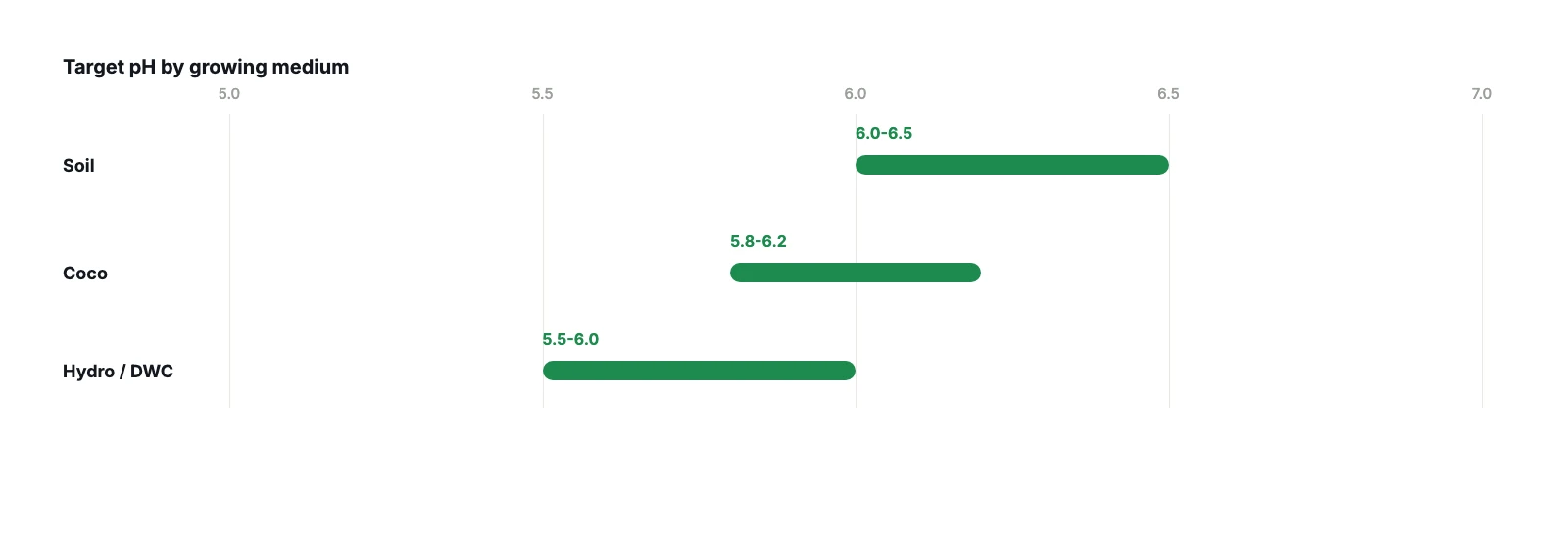
The two columns are not the same number, and in coco that catches people out. Feeding coco at 5.8-6.2 because that is what the substrate should read will walk the root zone up over time. Feed at 5.5-6.0 and let the medium sit where it should.
Check runoff pH before adding anything. Correcting pH and waiting a few days is usually faster than chasing a nutrient problem that isn't one. Our soil range is deliberately tighter than the 6.0-7.0 a lot of charts print. Soil will tolerate the top of that, but the cannabis-specific research only reaches to about 6.5, so we stay inside what the evidence actually covers.
This matters most for iron. Which chelate your iron is bound to starts to matter above about pH 6.5, and EDTA, the most common one, is the least stable of them, so above that you can be feeding an iron product the plant can no longer fully access. If you're in soil and chasing an iron symptom specifically, the lower half of the range works in your favor. Don't chase it below 6.0 though, because magnesium availability starts dropping off under that, and trading an iron problem for a magnesium one isn't progress. Magnesium is not the only thing you lose down there. Molybdenum runs backwards from every other nutrient on this page and locks out at low pH, so driving pH down to free up iron can starve the plant of molybdenum instead. That is the whole reason for the floor.
2. Is It Too Much Nitrogen?
Nitrogen above roughly 160 mg/L suppresses the plant's uptake of phosphorus, calcium, magnesium, and manganese. It doesn't matter that those nutrients are in the reservoir. The plant takes up less of them anyway.
This is the trap in a deficiency article, so it's worth spelling out. A grower pushing nitrogen hard through stretch sees calcium or magnesium symptoms appear, reads a chart, and reaches for a cal-mag supplement. It doesn't fix it, because the shortage was never in the bucket. The nitrogen was blocking the door. And most cal-mag products carry nitrate nitrogen themselves, so the correction adds more of the thing causing the problem.
Worth reconciling this against the table further down, because the two can look like they disagree. That table runs nitrogen up to 200 mg/L through stretch, above the level where suppression starts. That is deliberate, but it is a trade and you should know what you are trading.
The evidence does not point one way. One cannabis trial fitted a flowering optimum near the top of that band, which is the case for running it high. Another found bud weight stopped improving above 160 while cannabinoid concentration fell as nitrogen climbed. So the extra nitrogen may buy you nothing on weight and cost you on potency, on top of the calcium and magnesium suppression already described.
Pulling flower nitrogen down is one of the better-studied ways to raise potency, worth something in the region of 10 to 20 percent on cannabinoid concentration. If that is what you are growing for, the top of the stretch band is the wrong place to sit. If you are growing for weight, it is defensible. It is a choice, not a default, and nobody should be running 200 by accident.
3. Is It Too Much Potassium?
High potassium suppresses magnesium uptake, and the figure we have for where it starts is around 175 mg/L. The effect is asymmetric: potassium holds magnesium back considerably more than magnesium holds back potassium.
A complete feeding program run at its normal rates is unlikely to get you there. This is mostly a stacking problem. If you're layering a separate bloom or potassium booster on top of a base feed that already covers potassium, and lower leaves start yellowing between the veins in weeks 4 to 6 of flower, back the extra product off before you add magnesium.
Two honest caveats. That figure comes from a single cannabis trial whose growth stage is itself disputed, and coco releases potassium of its own that nobody has quantified.
Worth noting the same tension the nitrogen section has. Our own flowering rows run potassium at 150 to 180, so the top of that band sits right at the figure above. That is not an oversight either. That trial was not run at flowering and nobody has run the flowering equivalent, so it is the best marker we have rather than a hard ceiling. Sitting mid-band is the comfortable place to be.
Elemental Targets by Growth Stage
This table is for photoperiod plants. If you're growing autoflowers, don't read your meter against it. Every column is different and they don't all move the same way. The columns do not all scale the same way, so use a schedule built for autoflowers rather than adjusting this one.
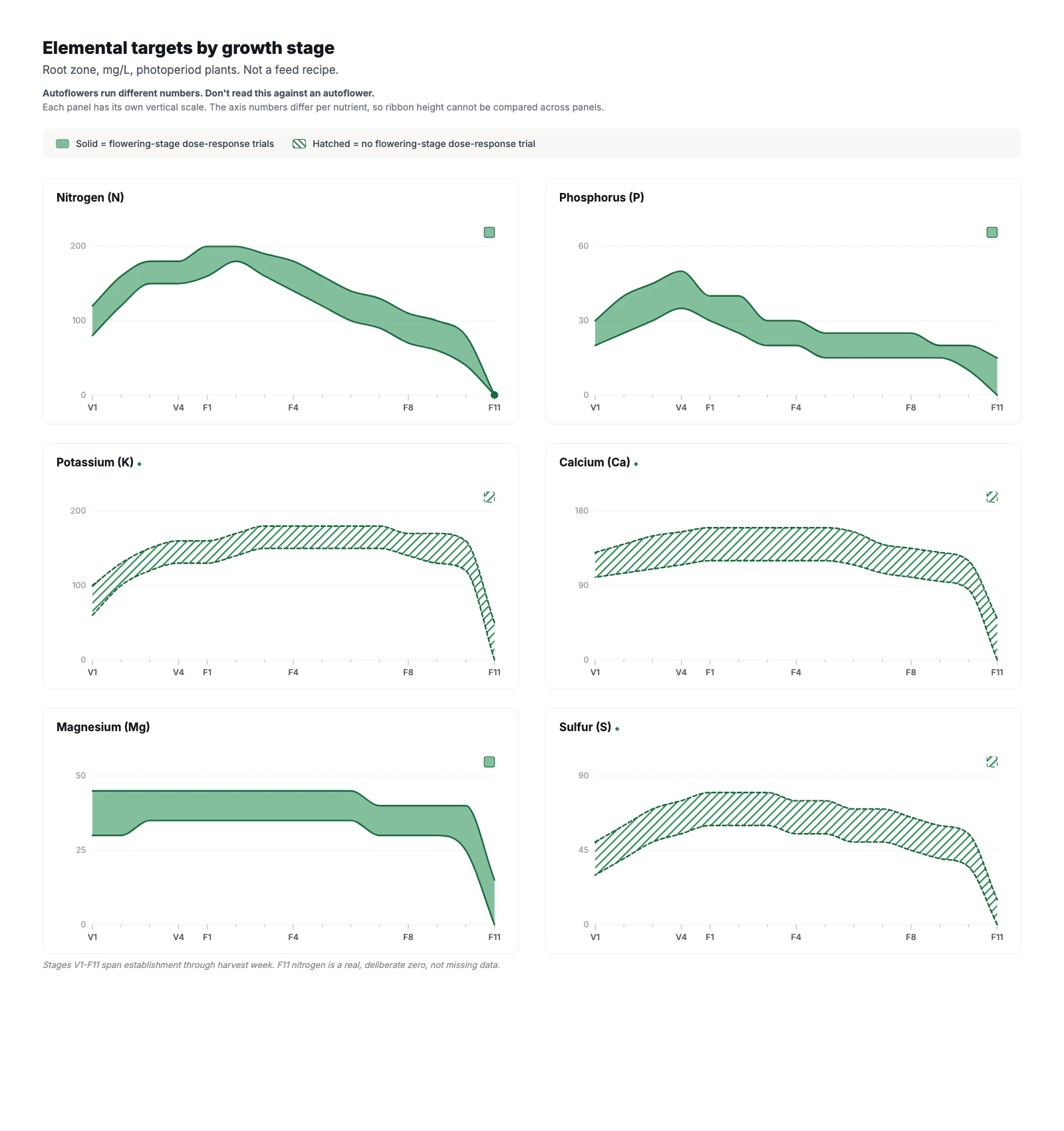
The deficiency chart earlier in this guide tells you what a shortage looks like. This table, and the chart above it, show a reasonable working range for what a photoperiod plant needs at each stage, in mg/L (equivalent to ppm, elemental basis, not the oxide numbers printed on fertilizer labels). The table below carries the same numbers as the chart in HTML text, so the data isn't locked inside the image.
Your TDS pen cannot check your feed against this table, and it's worth being clear about why. A TDS or ppm meter reads total dissolved solids, derived from electrical conductivity. It reports everything in the water as one number and cannot tell you how much of it is nitrogen. If your pen reads 900 and you compare that to the 120-160 nitrogen column, you'll conclude you're overfeeding by six times, and you won't be. These figures come from a water analysis or from calculating what a given feed delivers. To cross-check with a meter, use the EC or ppm figures on whatever schedule you're following, which are built for exactly that. This table is for confirming a diagnosis on paper, not at the reservoir.
| Stage | N | P | K | Ca | Mg | S |
|---|---|---|---|---|---|---|
| V1 Establishment | 80-120 | 20-30 | 60-100 | 100-130 | 30-45 | 30-50 |
| V2 Early veg | 120-160 | 25-40 | 100-130 | 105-140 | 30-45 | 40-60 |
| V3 Mid veg (steady) | 150-180 | 30-45 | 120-150 | 110-150 | 35-45 | 50-70 |
| V4 Late veg | 150-180 | 35-50 | 130-160 | 115-155 | 35-45 | 55-75 |
| F1 Stretch (early) | 160-200 | 30-40 | 130-160 | 120-160 | 35-45 | 60-80 |
| F2 Stretch (peak) | 180-200 | 25-40 | 140-170 | 120-160 | 35-45 | 60-80 |
| F3 Pre-flower | 160-190 | 20-30 | 150-180 | 120-160 | 35-45 | 60-80 |
| F4 Bud initiation | 140-180 | 20-30 | 150-180 | 120-160 | 35-45 | 55-75 |
| F5 Early bud fill | 120-160 | 15-25 | 150-180 | 120-160 | 35-45 | 55-75 |
| F6 Mid bud fill | 100-140 | 15-25 | 150-180 | 115-155 | 35-45 | 50-70 |
| F7 Mid-late bud fill | 90-130 | 15-25 | 150-180 | 105-140 | 30-40 | 50-70 |
| F8 Bud maturation | 70-110 | 15-25 | 140-170 | 100-135 | 30-40 | 45-65 |
| F9 Late bud fill (steady) | 60-100 | 15-20 | 130-170 | 95-130 | 30-40 | 40-60 |
| F10 Ripening | 40-80 | 10-20 | 120-160 | 85-120 | 25-40 | 35-55 |
| F11 Harvest week | 0 | 0-15 | 0-50 | 0-50 | 0-15 | 0-15 |
V1 to V4 are vegetative weeks. F1 to F11 are flower weeks counted from the flip, not from seed.
Three things worth knowing before you read this like a target to hit exactly.
Nitrogen rises through the stretch before it tapers hard into ripening. Staying on veg-level nitrogen too long into flower is one of the more common overfeed patterns, not an underfeed one. And harvest week is a real zero on nitrogen, so the yellowing lower leaves at the very end are the plant doing what it should. That is the plant's own metabolic wind-down, not an argument for flushing. Running plain water for the last two weeks has been tested and does not improve terpenes. Don't chase a low reading in ripening. It's expected.
Phosphorus in flower is genuinely unsettled. This table drops phosphorus through flower, and two published cannabis trials point to a low flowering requirement, though one of them is itself contested. A third fitted a flowering optimum around three times as high, and nobody has reconciled the three. The likely explanations are strain type and growing system, since the trials differ on both. The lower band is the better bet, because two of three support it and because excess phosphorus suppresses zinc and iron uptake. Treat it as a current best read rather than a settled number, and don't let anyone tell you the question is closed in either direction.
Three columns are softer than the other three. The nitrogen, phosphorus, and magnesium figures rest on trials where somebody fed cannabis a range of concentrations and measured what happened. Potassium, calcium, and sulfur don't have that. Nobody has run a calcium or sulfur dose-response study in cannabis, and the flowering potassium range is inherited practice rather than a measured optimum. Those three come from healthy plants that happened to be fed a known amount, which gives you a workable number but not an optimal one.
What Your Medium Does to These Numbers
The table above is what the plant should see at the root. That is not always what you mix. Some media hand the plant everything you feed, some hold part of it back, and one of them makes the whole table irrelevant.
| Medium | What to feed | Why |
|---|---|---|
| Hydro, DWC, NFT, rockwool | The table, exactly as written | Nothing buffers. What you mix is what the root sees |
| Coco coir, drain to waste | The table, but for the first two to four weeks raise calcium and magnesium only by 10 to 15 percent. Leave every other column alone, and drop back to the table once the medium is charged | Coco holds calcium and magnesium on its exchange sites early in a grow and releases potassium in return |
| Peat mixes (Pro-Mix, Ocean Forest and similar) | Plain pH'd water is often enough for the first two or three weeks. After that, the table, nudged up around 10 to 20 percent | These ship with a starter charge that feeds the plant early, then run out |
| Native soil, outdoors | Get a soil test and feed the gap, not the target | Your soil already supplies some of this and you cannot know how much without testing |
| Living or super soil | This table does not apply. Feed the soil biology, not the plant | Nutrients are released by the soil food web on its own schedule, not by what you pour in |
The coco adjustment is calcium and magnesium only. Raising all six columns by 10 to 15 percent is a common mistake and it overfeeds nitrogen, phosphorus and potassium to fix a calcium problem. Move the two that the medium actually holds back. And only while it is holding them back. Once the exchange sites are saturated, a few weeks in, keep feeding the raised figure and you are simply overfeeding calcium and magnesium.
What Mistakes Do Growers Make Diagnosing This?
| Mistake | What's actually happening |
|---|---|
| Adding more nutrients when two or three symptoms appear together | Usually pH lockout, not a deficiency. Check runoff pH first. |
| Treating late-flower lower-leaf yellowing as nitrogen deficiency | Often normal late-flower fade, the plant moving nitrogen into bud development. Don't chase it in the last few weeks. |
| Diagnosing immediately after heavy defoliation | Temporary yellowing and drooping is normal for 5-7 days afterward. Wait before treating. |
| Assuming purple stems always mean phosphorus deficiency | Cold root-zone temperature and genetics both cause the same look. Rule out temperature first. |
| Confusing iron deficiency with magnesium deficiency | Both are interveinal yellowing with green veins. Location is the tell: iron on new growth, magnesium on old. |
| Ruling out zinc because you saw interveinal yellowing and called it iron | Zinc deficiency is interveinal too. Leaf size and internode spacing separate them, not color. |
| Adding calcium and magnesium while running high nitrogen | Nitrogen above roughly 160 mg/L blocks their uptake, and most cal-mag products carry nitrate nitrogen, adding to the problem. Lower nitrogen first, wait a week, then reassess. |
| Stacking a separate bloom booster, then adding magnesium when lower leaves yellow | Extra potassium on top of a complete feed can suppress magnesium uptake. Back the added product off before adding more magnesium. |
| Ruling out copper because you haven't seen the textbook new-growth symptoms | Copper takes about nine weeks to show at all in the one available trial, and that same trial found an earlier stage on lower leaves that looks nothing like the classic pattern. Don't rule it out from timing or leaf position alone. |
| Checking an autoflower's feed against the photoperiod table | Every column differs and they don't move together. Use a schedule built for autoflowers. |
The Bottom Line
Start with location, not color. Old growth points to nitrogen, phosphorus, potassium, magnesium, or molybdenum. New growth points to calcium, iron, manganese, zinc, boron, or sulfur, and on new growth it's leaf shape and internode spacing that separate them rather than the yellow itself.
Before you add anything, rule out the three things that look like deficiencies and aren't: pH outside your medium's window, nitrogen high enough to block calcium and magnesium, and potassium high enough to block magnesium. All three are more common than the shortage they imitate, and all three get worse if you respond by feeding more. Once you've narrowed it down, the fix is usually one adjustment, not a full feed overhaul.
Where Do These Numbers Come From?
The stage targets above come from our own photoperiod reference, which is built from the cannabis research below. Where a study was run on hemp, another crop, or a particular chemotype, we say so, because that limits how far the finding travels.
| What it supports | Study |
|---|---|
| Nitrogen above roughly 160 mg/L suppressing phosphorus, calcium, magnesium and manganese uptake | Saloner & Bernstein 2020. Drug-type cannabis, vegetative stage, solution culture. 10.3389/fpls.2020.572293 |
| Bud weight levelling off above 160 mg/L nitrogen while cannabinoid concentration falls | Dilena, Hunt & Close 2025. Medicinal cannabis, five nitrogen rates across five clonal lines. 10.1038/s41598-025-96761-6 |
| A flowering nitrogen optimum near the top of our band | Bevan et al. 2021. Drug-type cannabis in deep water culture. 10.3389/fpls.2021.764103 |
| Magnesium 30 to 45 mg/L with an optimum near 35 | Bernstein lab, 2025. Cannabis dose-response across 2 to 140 mg/L. 10.1186/s42238-025-00358-9 |
| Zinc optimum near 0.35 mg/L, with deficiency and excess both reducing cannabinoids | Shiponi & Bernstein 2026. 10.1186/s42238-026-00404-0 |
| Calcium sufficiency near 130 mg/L, and a 44 percent floral yield loss without it | Llewellyn et al. 2023. Single-element deficiency screen, hydroponic, one cultivar. 10.3390/plants12030422 |
| Flower phosphorus as low as 15 mg/L being enough for maximum yield | Hershkowitz, Westmoreland & Bugbee 2025. Recirculating hydroponics, high-CBD chemotype. 10.3389/fpls.2025.1433985 |
| Potassium suppressing magnesium far more than magnesium suppresses potassium | Xie, Cakmak et al. 2021. A review across higher plants generally, not cannabis-specific. 10.1016/j.cj.2020.10.005 |
| Magnesium uptake falling away above roughly 175 mg/L potassium | Saloner & Bernstein 2022. Cannabis, five potassium levels from 15 to 240 mg/L. The trial's growth stage is disputed and nobody has run the flowering equivalent. 10.3390/agronomy12051242 |
| Lower flower nitrogen raising cannabinoid concentration by roughly 10 to 20 percent | Saloner & Bernstein 2021 and 2023, with Dilena, Hunt & Close 2025. 10.1038/s41598-025-96761-6 |
| Flushing with plain water for the last two weeks not improving terpenes | Saloner, Sade & Bernstein 2024. Five cultivars, no meaningful terpene increase. 10.1016/j.indcrop.2024.119157 |
| Copper deficiency symptomology and the roughly nine-week onset | Cockson et al. 2019. CBD hemp cultivar ’T1’, controlled greenhouse trial, not drug-type cannabis. 10.3390/app9204432 |
| Copper tissue sufficiency of 5 to 11 mg/kg | NC State Extension 2024. Hemp floral tissue analysis, 6,119-sample field and greenhouse dataset, not drug-type cannabis. NC State Extension |
Potassium, calcium and sulfur are missing from that list for different reasons, and all three are worth knowing. Nobody has ever run a dose-response study on calcium or sulfur in cannabis, so our figures for those two come from healthy plants that happened to be fed a known amount. Potassium is stranger: one cannabis trial did test five potassium levels, and it landed on an optimum of 60 mg/L, well under the 150 to 180 our flowering rows carry. Even that trial's growth stage is now disputed, and no one has run the flowering equivalent. So the honest position on flowering potassium is that it rests on inherited practice, not measurement. That is why all three are drawn differently in the chart above.
Related reading: Why Are My Plant Leaves Turning Yellow?, Why Are My Stems Purple or Red?, and Why Is My Plant's Growth Uneven or Stunted? go deeper on each individual symptom.
Still not sure what you're looking at? Send us photos through our diagnostic form and our grow support team will work through it with you. Clear shots of the affected leaves, plus your medium, your pH, what you're feeding, and where you are in the grow, get you a real answer instead of a guess.