
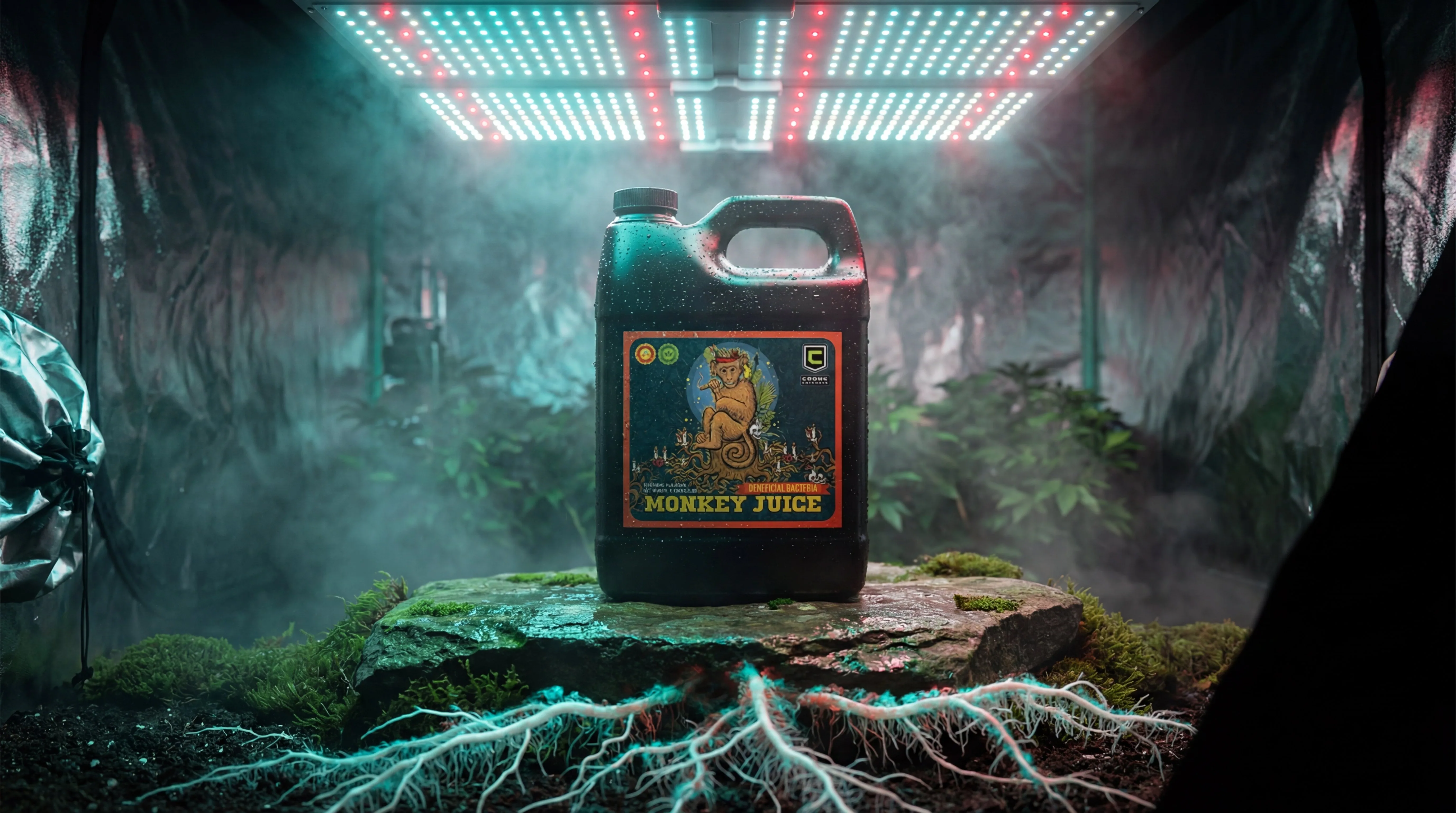
Monkey Juice is a concentrated beneficial bacteria inoculant containing Bacillus subtilis and Bacillus licheniformis, two scientifically proven plant growth-promoting rhizobacteria (PGPR). These microorganisms colonize root zones, improve nutrient availability, suppress pathogens, and boost plant stress tolerance through documented biological mechanisms.
This guide covers the science, benefits, application rates, and how to mix Monkey Juice correctly (which is different from how most guides explain it).
The science behind beneficial bacteria
What are plant growth-promoting rhizobacteria?
PGPR are bacteria that live in the rhizosphere (the root zone) and provide measurable benefits to plant growth and health. They work through four mechanisms:
- Direct growth promotion by producing plant hormones and improving nutrient availability
- Biocontrol by suppressing pathogens through competition and antimicrobial compounds
- Induced resistance by triggering the plant's own immune response
- Nutrient cycling by breaking down organic matter and solubilizing locked nutrients
Bacillus subtilis
One of the most studied beneficial bacteria in agriculture. It contributes three things:
Antimicrobial production. B. subtilis produces lipopeptide antibiotics (surfactin, iturin, fengycin) that disrupt pathogen cell membranes. These compounds are effective against Fusarium, Pythium, Rhizoctonia, and other root pathogens. Some foliar pathogens are also suppressed through induced resistance.
Induced systemic resistance. Root colonization by B. subtilis triggers the plant's defense pathways, essentially priming it to respond faster to future pathogen attacks. Protection extends to leaves and stems, not just roots. Think of it like a vaccination: the plant mounts stronger defenses when actually challenged.
Nutrient solubilization. B. subtilis produces organic acids that solubilize phosphorus, breaks down organic matter to release locked nutrients, and produces siderophores that improve iron availability.
Bacillus licheniformis
Complementing B. subtilis, B. licheniformis adds:
Enhanced decomposition. Produces powerful proteases and other enzymes that break down organic matter faster than most bacteria. Releases nitrogen, phosphorus, and micronutrients from organic sources.
Phosphorus solubilization. Particularly effective at releasing locked phosphorus. Produces the phytase enzyme which specifically breaks down phytates (organic phosphorus storage forms). Works synergistically with B. subtilis for comprehensive nutrient cycling.
Stress tolerance. Helps plants tolerate drought and heat. Produces protective compounds that maintain root cell integrity during stress events.
The spore-forming advantage
Both Bacillus species form endospores, which are dormant structures that can:
- Remain viable for years without refrigeration
- Survive harsh conditions (heat, desiccation, pH extremes)
- Germinate when conditions are right (moisture, nutrients, plant roots present)
- Ensure the product stays stable throughout its shelf life
This is why Monkey Juice doesn't need refrigeration and stays effective even if it sits on your shelf for a while.
Benefits of adding Monkey Juice to your grow
Root health
- Protects against root rot pathogens (Pythium, Fusarium, Rhizoctonia)
- Promotes healthy white root development
- Improves root zone microbial balance
- Reduces transplant shock
Nutrient availability
- Solubilizes locked phosphorus
- Breaks down organic matter into plant-usable forms
- Improves micronutrient availability (especially iron)
- Enhances overall nutrient cycling in the root zone
Plant immunity
- Triggers induced systemic resistance (ISR)
- Primes plants for faster pathogen response
- Provides ongoing protection throughout the grow cycle
- Reduces reliance on chemical disease control
Stress tolerance
- Improves drought tolerance
- Enhances heat stress recovery
- Supports plants during environmental challenges
- Maintains growth during suboptimal conditions
Application rates by system
| Growing system | Rate | Frequency |
|---|---|---|
| Soil | 2 to 4 mL per gallon | Once per week |
| Coco coir | 2 to 4 mL per gallon | Once per week |
| Living soil (PuurOrganics) | 2 mL per gallon | Once per week |
| Hydro reservoir | 1 to 2 mL per gallon | At each reservoir change |
| DWC / RDWC | 1 mL per gallon | At each water change |
Why these rates work
Unlike nutrients that get consumed, you're introducing living organisms that colonize and multiply on their own. Bacillus species form persistent colonies in the root zone, reproducing using root exudates and organic matter as food. You're seeding a colony, not maintaining a concentration, so more isn't always better. Overdoing it can throw off the microbial balance and compete with your plants for oxygen in closed systems.
Special applications
- Transplant: 4 mL per gallon to help establish in the new medium
- Root recovery: 4 mL per gallon temporarily in soil or coco if you're troubleshooting root issues
- Seed starting: 2 mL per gallon for early colonization of the root zone
How to mix Monkey Juice (the part most guides get wrong)
Monkey Juice is always the last thing you add, after pH adjustment is already complete. Here's why and here's the correct sequence:
The correct mixing order
- Armadillo Armour (if using) — always first, always to plain water. Stir 30 seconds, wait 5 minutes.
- CalMag (or PuurCalMag for PuurOrganics) — stir 30 seconds, wait 2 minutes.
- Base nutrients — Micro, Grow, Bloom for Classic. Bonnie or Clyde for Autoflower. PuurNitro through PuurBalance for PuurOrganics.
- Bud Booster (if using, flower stage, Classic or Autoflower only) — stir 30 seconds.
- Sticky Bandit (highly recommended with Monkey Juice) — stir 30 seconds. More on why this combo matters below.
- Adjust pH to your target range for the medium (see below). Use pH Up or pH Down in small increments.
- Monkey Juice — LAST, after pH is already correct. Add it directly to the finished, pH-adjusted solution and stir gently.
Why Monkey Juice has to go LAST, after pH
pH Down is phosphoric acid (or citric acid, or nitric acid depending on brand). Those acids kill live bacteria on contact. If you add Monkey Juice before you adjust pH, then pour pH Down into the same reservoir, you've just paid for a bottle of dead bacteria.
The rule: adjust pH to your target FIRST, let it stabilize, then add Monkey Juice as the final step. After Monkey Juice is in, don't touch pH again that feed. If you need to correct pH later, do it at the next feeding, not this one.
pH targets by medium
| Medium | Target pH (adjust BEFORE Monkey Juice) |
|---|---|
| Soil | 6.3 to 6.8 |
| Coco coir | 5.8 to 6.2 (hard cap at 6.5) |
| Hydroponics | 5.8 to 6.0 with drift |
| Living soil (PuurOrganics) | Don't pH the feed water, add Monkey Juice directly |
The Sticky Bandit plus Monkey Juice combo
Sticky Bandit is a carbohydrate additive, and beneficial bacteria eat carbohydrates. Running them together is a straightforward feedback loop:
- Monkey Juice provides the beneficial bacteria
- Sticky Bandit provides the food (carbohydrates) that feed them
- Well-fed bacteria colonize faster and more densely
- More bacteria means more antimicrobial compounds, more nutrient cycling, and more induced systemic resistance
The synergy is documented in agricultural research. If you're running Monkey Juice, you should probably be running Sticky Bandit with it for maximum benefit.
Plants and growing systems
Soil and living soil (best results)
Maximum benefit. Systems with organic matter give bacteria food sources, bacteria establish readily, and the full soil food web benefits from PGPR addition. PuurOrganics growers especially should run Monkey Juice.
Coco coir (excellent results)
Coco is a good habitat for bacteria. Pair with Sticky Bandit for the carbohydrate food source since coco has less inherent organic matter than soil.
Hydroponics (compatible with caveats)
Works in hydro but requires adjusted rates and careful management:
- Use lower rates: 1 to 2 mL per gallon for reservoir tanks, 1 mL per gallon for DWC/RDWC
- Less frequent: add only once per water or reservoir change, not per feeding
- Don't use hydrogen peroxide or chlorine in the reservoir (kills bacteria)
- Maintain proper aeration because bacteria need oxygen to thrive
- Keep reservoir temperatures between 65 and 72°F (warmer water holds less oxygen and encourages unwanted microbes)
- Bacteria will colonize root surfaces even in water culture
Compatibility
Compatible products
- All Cronk nutrient lines (Classic 3-Part, Bonnie & Clyde, PuurOrganics)
- CalMag and PuurCalMag
- Sticky Bandit (recommended combination)
- Bud Booster and Armadillo Armour
- Compost teas and other microbial products
- Mycorrhizal inoculants (different type of beneficial microbe, plays nicely with Bacillus)
NOT compatible
- Hydrogen peroxide (H₂O₂) — kills bacteria on contact
- Chlorine or chloramine — kills bacteria
- UV sterilization — kills bacteria
- Ozone treatment — kills bacteria
- Most fungicides — kill beneficial bacteria along with the pathogen
If you're running any of these sterilization methods, you can't run Monkey Juice at the same time. Pick one approach: either sterile hydroponic management, or biological management with Monkey Juice and other live inoculants.
Signs Monkey Juice is working
- Healthy white root systems that look clean and fibrous
- Improved plant vigor
- Better stress recovery after heat events or environmental stress
- Reduced disease incidence
- Stronger nutrient response (plants respond faster to feed changes)
- Healthy, earthy smell in the root zone (not sour or chemical)
Frequently asked questions
What makes Bacillus bacteria effective for plants?
Bacillus species are plant growth-promoting rhizobacteria (PGPR) with documented benefits. They colonize root surfaces, produce antimicrobial compounds that suppress pathogens, trigger the plant's own immune response, and help unlock nutrients that would otherwise stay bound in the soil. Agricultural research has documented these mechanisms for decades.
Why does Monkey Juice go last in the mixing order, after pH adjustment?
pH Down is phosphoric acid (or similar). Those acids kill live bacteria on contact. If you add Monkey Juice before pH Down, you're adding live bacteria and then immediately killing them. Adjust pH first, let it settle at your target, then add Monkey Juice as the final step.
Does Monkey Juice raise or lower solution pH?
Neither significantly. Bacillus bacteria have minimal direct impact on pH at normal application rates. Over time in soil they can slightly lower pH as they release organic acids during decomposition, but in a freshly mixed reservoir you won't see a meaningful pH shift from adding Monkey Juice.
Can I use Monkey Juice with PuurOrganics?
Yes, absolutely. PuurOrganics is where Monkey Juice shines. Living soil systems have the most organic matter and the most diverse microbial community, which gives Bacillus the best environment to colonize and thrive.
Can I use Monkey Juice in DWC or RDWC?
Yes, at a reduced rate of 1 mL per gallon. Keep the reservoir well aerated and in the 65 to 72°F range. Don't run hydrogen peroxide or chlorine in the same reservoir. Bacteria will colonize your root mass even in water culture, as long as the environment supports them.
Does Monkey Juice need refrigeration?
No. Both Bacillus species form endospores, which are dormant structures that remain viable for years at room temperature. Store the bottle capped, out of direct sunlight, in a stable-temperature area.
Can I combine Monkey Juice with mycorrhizal inoculants?
Yes. Bacillus bacteria and mycorrhizal fungi are complementary, not competing. One colonizes root surfaces and the rhizosphere, the other forms symbiotic relationships with root cells. Running both gives broader microbial coverage.
What happens if I overdose Monkey Juice?
In soil or coco, minimal harm. The plant just uses what it needs and the rest stays dormant or dies off. In closed hydro systems (DWC, RDWC), overdosing can cause bacterial blooms that compete for dissolved oxygen and potentially stress roots. Stick to 1 mL per gallon in DWC/RDWC to avoid this.
How soon will I see results after adding Monkey Juice?
Initial root zone colonization happens within a few days. Visible plant benefits (vigor, stress tolerance, disease resistance) typically show up over 2 to 4 weeks as the colony establishes and starts producing its secondary metabolites. Long-term benefits compound as the colony matures.
Related resources
Still have questions?
Email our grow support team at [email protected]. Include your medium, current mix schedule, and what you're trying to achieve, and we'll walk through how to integrate Monkey Juice. We reply within 24 hours.