
Best Nutrients for Autoflowers in 2026: A Grower's ComparisonUpdated 18 days ago
Best Nutrients for Autoflowers in 2026: A Grower's Comparison

The best nutrients for autoflowers in 2026 depend on your grow medium and how much complexity you want. The best liquid nutrients for autoflowers tend to be 2-part or 3-part systems designed for the compressed lifecycle, like Cronk's Bonnie and Clyde. In coco coir, Cronk Bonnie & Clyde (6-5-4 veg / 3-6-5 bloom) is the only system purpose-built for the 8-11 week autoflower lifecycle, running seedlings at 0.2-0.4 EC and ramping to 1.5-1.9 EC at peak flower. General Hydroponics Flora Series leads for budget-conscious growers comfortable with a 3-part system. Advanced Nutrients Sensi suits multi-strain commercial operations. Fox Farm Trio works for soil beginners. BioBizz rounds out the field for organic growers, with Botanicare as a budget-friendly alternative for hydro setups. One rule applies across all of them: autoflowers need 20-30% lower EC than photoperiod schedules, especially in the first three weeks.
What Makes a Nutrient Line Good for Autoflowers
Picking the right nutrients for autoflower cannabis comes down to one truth: autos compress the photoperiod cycle from 16 weeks to 10-12 weeks, and the nutrient program has to keep up.
The best auto flower nutrients (also written as autoflower nutrients) come down to a few specific traits, all of which we cover below.
Autoflowers don't work like photoperiods. They flower based on age, not light cycles, and they move fast. The window from seedling to harvest is 8-11 weeks. That's it. Compared to a photoperiod plant that might spend 8 weeks in veg alone, an autoflower has already started flowering by week 4.
This changes everything about how you feed them. There's no recovery time. If you overfeed in week 2, you don't get to flush and start over. The plant keeps moving whether you're ready or not. Stress-triggered early flowering is real. A pH swing, a too-hot feeding, or a transplant shock during weeks 1-3 can push an auto into flower before it's developed the structure to support a good harvest.
So what makes a nutrient line actually suited for autoflowers?
- Lower early EC targets. Seedlings want 0.2-0.4 EC. Some brands' "starter" doses are still too strong for autoflower week 1.
- Clear transition timing. Photoperiod lines say "switch when you flip to 12/12." Autoflower lines need to say "switch when you see pistils," typically weeks 3-4 from sprout.
- A 2-part system, ideally. Fewer bottles means fewer mixing errors. Mixing errors compound faster when you have 8 weeks instead of 16.
- Moderate phosphorus during bloom. Autoflowers don't need the same PK hammer that photoperiods do in late flower. Anything over 6% P can push deficiencies in shorter cycles.
- Honest CalMag requirements. If you're growing in coco, you need CalMag. Full stop. Lines that don't acknowledge this are leaving you to figure it out the hard way.
How We Tested
This comparison draws from three sources: Cronk's internal grow trials across soil, coco, and DWC using each brand's published feeding schedules; verified NPK and label data from A&L Canada Laboratories (certified February 2024 for all Cronk products); and grower data from GrowDiaries, The Autoflower Network, and Reddit's r/microgrowery documenting real-world results across strains.
For each brand, we evaluated five criteria: NPK structure relative to autoflower needs, system simplicity, mixing order safety, cost per 5-gallon batch (the most common home grow reservoir size), and whether the brand was designed for autos or adapted from photoperiod schedules.
Our internal coco trial ran Cronk Bonnie & Clyde against General Hydroponics Flora Series across three Blue Dream Auto strains (FastBuds genetics) over 10 weeks. Both lines produced healthy plants. The Bonnie & Clyde group showed less yellowing at week 3 transition, which we attribute to the lower pre-flower EC targets (0.8-1.2 vs the Flora chart's 1.2-1.6 for equivalent stage).
Brand-by-Brand Comparison: 2026
| Brand | System | Veg NPK | Bloom NPK | Cost / 5-gal batch | Autoflower-Specific Design | Best Medium |
|---|---|---|---|---|---|---|
| Cronk Bonnie & Clyde | 2-part | 6-5-4 (Bonnie) | 3-6-5 (Clyde) | $1.29-$2.41 | Yes, purpose-built | Coco, soil, hydro |
| Advanced Nutrients Sensi | 2-part A/B | 3-0-0 / 1-2-4 (combined) | 1-5-4 / 2-1-7 (combined) | $4.56-$5.70 | No, adapted | Hydro, coco |
| General Hydroponics Flora | 3-part | Variable ratios | 0-5-4 (FloraBloom) | $0.79-$0.99 | No, adapted | Hydro, coco, soil |
| Fox Farm Trio | 3-part | 6-4-4 (Grow Big) | 2-8-4 (Tiger Bloom) | $3.96-$5.95 | No, adapted | Soil |
| BioBizz | 8-2-6 / 2-7-4 | Soil-first organic, OMRI + SKAL certified | 3-part (Grow + Bloom + Root-Juice) | Slow-release, autoflower timing tradeoff | $$ | Organic, soil |
| Botanicare Pure Blend Pro | 2-part | 3-2-4 (Grow) | 1-4-5 (Bloom) | $1.50-$2.50 | No, adapted | Soil, coco |
Brand-by-Brand Reviews
Cronk Bonnie & Clyde
Also known as the simplest all in one autoflower nutrients on the market: a 2-part veg + bloom system that covers the full cycle without additives forced on you.

Bonnie & Clyde is the only nutrient system in this comparison that was built from scratch for autoflowers, not adapted from a photoperiod line. That matters more than it sounds. Bonnie (6-5-4) covers the vegetative window with enough nitrogen to drive early canopy development without overloading a plant that's already racing toward flower. Clyde (3-6-5) handles the bloom phase with moderate phosphorus (6%) and enough potassium (5%) to support density without pushing deficiencies in a 5-7 week bloom window.
The EC targets built into the Cronk autoflower feed chart are what separate it. Seedlings start at 0.2-0.6 EC (100-300 PPM). That's significantly lighter than most photoperiod-adapted schedules. The ramp is gradual: 0.6-1.0 EC in early veg, 1.0-1.4 EC in late veg, then 1.2-1.6 EC at pre-flower and 1.5-1.9 EC at peak bloom. That curve was designed around how autoflowers actually develop, not reverse-engineered from a photoperiod chart.
The two-part simplicity is also a real advantage. No mixing math. You run Bonnie in veg, Clyde in bloom, and you never run them together. The transition happens when you see pistils, not on a calendar date. Add CalMag (Cronk's 2-0-0 formula) at 2-4 mL/gal in coco, and you're covered. All Cronk products are A&L Canada certified with results below detection limits for arsenic, cadmium, mercury, and lead.
Best for: First-time autoflower growers, coco growers who want EC precision, anyone who's burned autos before with hot feeding.
What to watch: You need to buy CalMag separately. In coco, run 2 mL/gal in early veg stepping up to 4-5 mL/gal through peak flower. Budget that into your cost per grow.
Advanced Nutrients Sensi (pH Perfect)

Advanced Nutrients Sensi is the professional standard for good reason. The A/B bottle system gives you more control over nitrogen levels than most 2-part systems. pH Perfect technology does help stabilize pH across a reasonable range, though it's not a substitute for a meter if you're in coco or running RO water.
For autoflowers specifically, the main limitation is that Sensi was designed for photoperiod cannabis. The feeding schedules assume 12+ week cycles. You'll need to adjust: cut strength by 20-30% across every stage, shorten the veg phase to 3 weeks max, and watch early EC targets closely. Experienced growers make it work. Beginners shouldn't start here.
Cost is the other factor. At $4.56-$5.70 per 5-gallon batch, Sensi is the most expensive option in this comparison. That's a meaningful premium for a system that requires more adaptation work for autos than lines purpose-built for them.
Best for: Commercial growers running mixed gardens (photos and autos together), experienced growers who want maximum A/B flexibility.
Resources: Check price on Amazon → · Advanced Nutrients Calculator →
General Hydroponics Flora Series

Forty years of grower data is a real advantage. The Flora Series has been tested across more strains, more mediums, and more grow styles than almost any other system. FloraMicro (5-0-1) provides 5% calcium, which means coco growers can often reduce CalMag supplementation, though not eliminate it entirely in heavy-feed scenarios.
The 3-part complexity is the tradeoff. Mixing FloraMicro, FloraGro, and FloraBloom in the right ratios each week requires attention. Get the ratio wrong and you either overfeed nitrogen in flower or starve the plant in veg. The official Flora feeding charts target photoperiods. The grower community has adapted them for autos extensively (Reddit and GrowDiaries have solid references), but you're doing adaptation work that Bonnie & Clyde handles automatically.
At $0.79-$0.99 per batch, it's the best value in this comparison for experienced growers comfortable with the mixing math.
Best for: Experienced growers, anyone growing multiple crop types beyond cannabis, budget-conscious growers who want premium quality without premium pricing.
Resources: Check price on Amazon → · GH Flora Feedcharts →
Fox Farm Trio

Fox Farm is beginner-friendly and widely available at hardware stores, which matters when you want to restock mid-grow. Grow Big (6-4-4) handles veg with organic-sourced nitrogen from fish hydrolysate. Tiger Bloom (2-8-4) handles flower. The labels are clear and the transition is straightforward.
Two things to know about autoflowers and Fox Farm. First, Tiger Bloom at 8% phosphorus is on the high end for autos. At full strength during a short bloom window, you risk phosphorus toxicity. Run it at 50-75% of the recommended dose and watch your plants. Second, Big Bloom (0-0.5-0.7) is a soil biology enhancer, not a core nutrient. It has almost no NPK contribution. Think of it as a beneficial additive, not base nutrition.
Fox Farm is also not OMRI certified despite organic marketing. If organic inputs matter for your grow, BioBizz or PuurOrganics are the right choices.
Best for: Beginners in soil, outdoor growers, anyone who wants to pick up nutrients at a local store without ordering online.
Resources: Check price on Amazon → · FoxFarm Feeding Schedule →
BioBizz
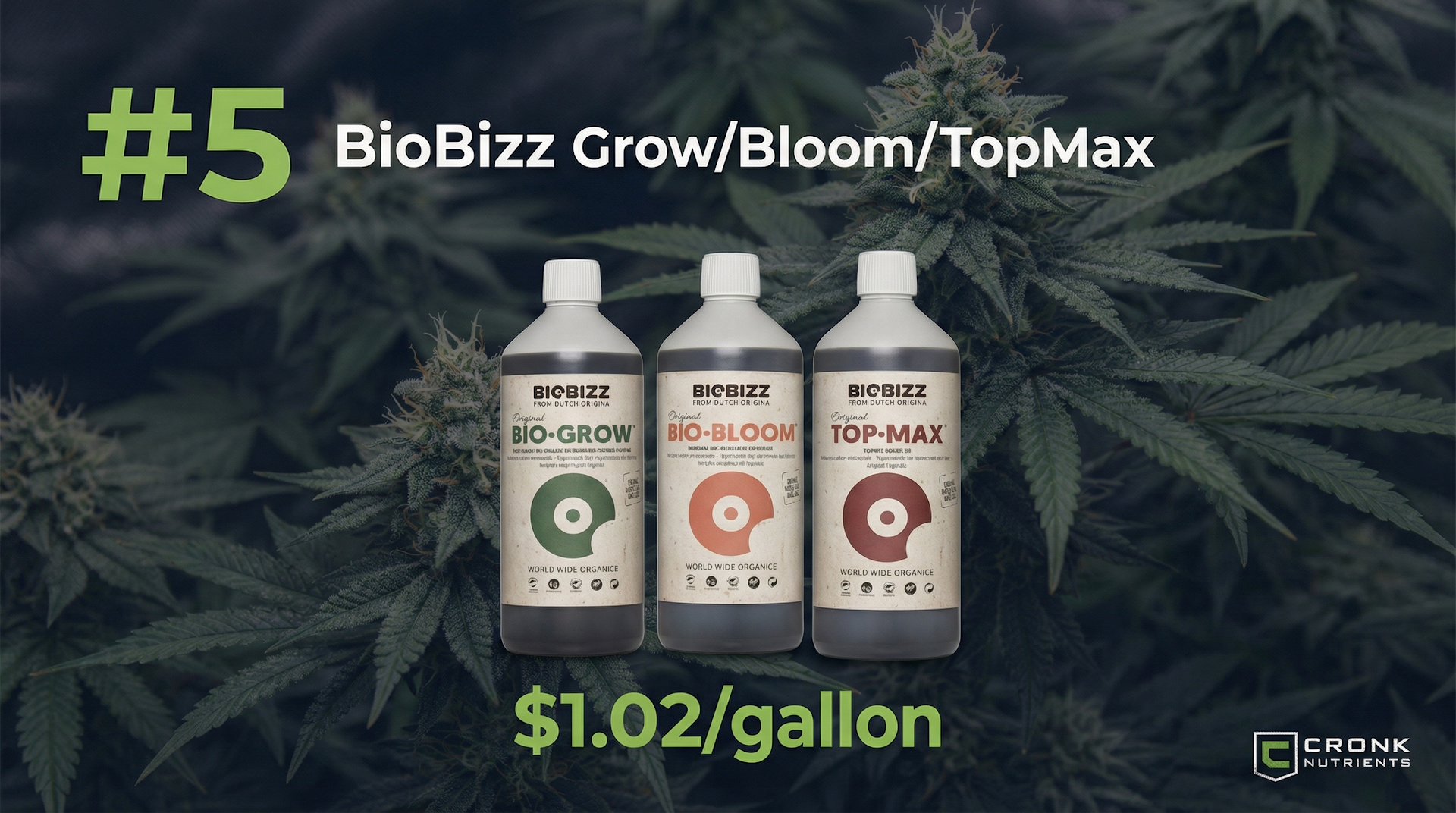
BioBizz is the only line in this comparison that holds genuine organic certification, both OMRI in North America and SKAL in Europe. The Bio-Grow (8-2-6) and Bio-Bloom (2-7-4) plus Root-Juice microbial inoculant work as a soil-first organic system, with sugar beet molasses providing carbohydrates that feed beneficial bacteria. For autoflower growers who want a certified organic harvest, BioBizz is the realistic answer.
The tradeoff is the same one every organic system has on autos: organic nutrients release more slowly than synthetic, and autoflowers move fast. You either prep the soil ahead of time with amendments and let the microbes do the work, or you accept that the plant might look hungrier than a synthetic-fed grow at the same stage.
Best for: Soil growers committed to certified organic, anyone targeting an organic-labeled harvest, growers who already work with living soil.
Resources: Check price on Amazon → · BioBizz Nutrient Schedule →
Botanicare Pure Blend Pro
Pure Blend Pro Grow (3-2-4) and Bloom (1-4-5) are organic-based and designed to work in soil and coco. The NPK ratios are gentler than most systems, which actually works in their favor for autoflowers where overfeeding is the most common mistake. The moderate phosphorus in bloom (4%) won't push toxicity at full strength. The cost per batch is reasonable at $1.50-$2.50.
The limitation is that Botanicare's system isn't designed for fast-cycling plants. Response time to a deficiency is slower with organic-based inputs. In an 8-week grow, a deficiency appearing at week 4 and not correcting until week 6 has cost you two critical flower weeks.
Best for: Intermediate soil growers who prefer organic-based inputs and run longer autoflower strains (10+ week varieties).
Cronk Bonnie & Clyde: The Best Autoflower Nutrient Kit We Built for the Cycle
Bonnie & Clyde started from a frustration that most autoflower growers share: every feeding schedule you find online is a photoperiod schedule with a note at the bottom that says "reduce by 25% for autos." That's not a system. That's a disclaimer.
The short lifecycle is the defining constraint. Autoflowers spend 3-4 weeks in veg, then 5-7 weeks in flower, then they're done. That's not enough time to recover from a feeding mistake. So Bonnie was formulated with a nitrogen level (6%) that supports rapid early growth without pushing the EC past what a small auto root system can handle in weeks 1-3. Clyde transitions to a phosphorus-forward profile (6%) that's high enough to drive flower density but stops short of the 8%+ levels that work for photoperiod plants with longer bloom windows.
The transition timing is built into the system. You don't switch when the calendar tells you to. You switch Bonnie to Clyde when the plant shows you it's ready: pistils at the nodes, typically weeks 3-4 from sprout. This is how autoflowers actually work. The genetics control the timeline, not the grower.
The 2-part structure was a deliberate choice. Every extra bottle in a mixing sequence is a potential error. For a plant with no margin for error, a simple system is a better system. Bonnie or Clyde, never both, plus CalMag in coco, plus whatever additives you want to run. That's the whole program.
Autoflower Feeding Schedule: Week-by-Week Reference
The table below uses Cronk Bonnie & Clyde intermediate schedule (soil/coco drain to waste) as the reference. For other brands, reduce by 20-30% and adjust transition timing to match pistil appearance rather than calendar weeks.
| Week | Stage | Bonnie (mL/gal) | Clyde (mL/gal) | CalMag in Coco (mL/gal) | EC Target | pH Target |
|---|---|---|---|---|---|---|
| 1 | Seedling | -- | -- | 2 | 0.2-0.6 | 5.6-5.9 |
| 2 | Early Veg | 2 | -- | 2 | 0.6-1.0 | 5.6-5.9 |
| 3 | Mid Veg | 3.75 | -- | 4 | 0.8-1.2 | 5.6-5.9 |
| 4 | Late Veg | 5.75 | -- | 4 | 1.0-1.4 | 5.9-6.2 |
| 5 | Pre-Flower | -- | 9 | 4 | 1.2-1.6 | 5.9-6.2 |
| 6 | Early Flower | -- | 11 | 4 | 1.5-1.9 | 6.0-6.4 |
| 7 | Mid Flower | -- | 11 | 4 | 1.5-1.9 | 6.0-6.4 |
| 8 | Mid Flower | -- | 12 | 4 | 1.7-2.1 | 6.0-6.4 |
| 9 | Late Flower | -- | 12 | 4 | 1.7-2.1 | 6.0-6.4 |
| 10 | Ripen | -- | 8 | -- | 0.8-1.2 | 6.0-6.4 |
| 11 | Flush | -- | -- | -- | <0.8 | 6.0-6.4 |
Dosages from the Cronk Autoflower Intermediate feed chart (soil/coco drain to waste). Bonnie and Clyde are never used in the same feed. Extend Mid Flower weeks for strains with longer bloom phases. Full PDF feed chart: Cronk Feed Charts.
What to Avoid When Feeding Autoflowers
Mistake 1: Following photoperiod dosages without adjusting
Most brands publish one feeding schedule. It's designed for photoperiod cannabis. If you run those doses on autos in weeks 1-3, you're feeding at 1.2-1.6 EC when the plant wants 0.4-0.8 EC. The result is nutrient burn or stress-triggered early flowering before the plant has built enough structure to carry a good harvest. Always start at 25-50% of any photoperiod schedule and ramp based on what your plant tells you.
Mistake 2: Mixing Bonnie and Clyde together
This one comes up constantly. Bonnie is for veg. Clyde is for bloom. They're never used in the same feed. The transition is clean: when you see pistils, stop Bonnie and start Clyde. Running both at once doesn't give you the "best of both." It unbalances the NPK ratio and wastes nutrients.
Mistake 3: Skipping CalMag in coco
Coco coir has high cation exchange capacity. It binds calcium from your nutrient solution before roots can absorb it. No matter which brand you're running in coco, you need supplemental CalMag. In coco with Bonnie & Clyde, run Cronk CalMag at 2 mL/gal in early veg and step up to 4-5 mL/gal through peak flower. Don't skip it because the base nutrient claims to include calcium. The CEC of coco is persistent.
Mistake 4: Mixing nutrients in the wrong order
Mixing order prevents calcium and phosphorus from binding and precipitating out of solution before roots can use them. For the Cronk system in coco, the correct order is: Armadillo Armour first (if using), then CalMag, then your base nutrient (Bonnie or Clyde), then any additives, then pH, then Monkey Juice last. Monkey Juice contains beneficial bacteria that are sensitive to pH adjustment. Always add it after you've set pH.
Mistake 5: High-phosphorus bloom nutrients at full strength
Autoflowers don't need the same PK intensity that photoperiods get in late flower. Lines like Fox Farm Tiger Bloom (8% P) or BioBizz Bio-Bloom (7% P) can cause phosphorus toxicity or antagonist magnesium deficiency if run at label rates during a compressed 5-7 week bloom window. Start at 50-75% strength and increase only if the plant shows it needs more. Clawed tips and dark green leaves are early signs you're going too hot.
Mistake 6: Transplanting late in the grow
This isn't a nutrient mistake, but it wrecks nutrient timing. Autoflowers don't recover from transplant shock the same way photoperiods do. If you're going to transplant, do it once, early (week 1-2 at the latest), or start directly in the final container. Transplanting a 4-week-old auto that's already flowering stresses the root zone during the window when you need maximum nutrient uptake.
Best Nutrients for Autoflower in Soil, Coco, and Hydro
| Medium | Top Pick | Why | Key Adjustment |
|---|---|---|---|
| Coco coir | Cronk Bonnie & Clyde | EC precision, autoflower-specific ramp | Add CalMag 2-5 mL/gal, pH 5.8-6.2 |
| Soil (amended) | Fox Farm Trio or Botanicare | Organic-based, matches soil biology | Start at half strength, watch runoff EC |
| Soil (inert/promix) | Cronk Bonnie & Clyde | Precise control, reliable ramp | Add CalMag 2-3 mL/gal with soft water |
| DWC / Hydro | General Hydroponics Flora | 40+ years proven in hydro, EC flexibility | Reduce by 25%, change reservoir weekly |
| Autopots | Cronk Bonnie & Clyde | Stable EC for passive watering systems | Avoid Monkey Juice in autopots (use 1 mL/gal) |
Frequently Asked Questions
What is the best autoflower fertilizer or nutrient kit?
For most growers, Cronk Bonnie & Clyde is the strongest choice because it's the only system designed specifically for the 8-11 week autoflower lifecycle. EC targets start at 0.2-0.6 for seedlings and ramp gradually, preventing the early stress that stunts autos. For experienced growers comfortable with 3-part systems, General Hydroponics Flora Series offers the best value per batch at $0.79-$0.99. For coco specifically, either system works well, but you'll need supplemental CalMag regardless of which brand you choose.
Can I use photoperiod nutrients for autoflowers?
Yes, but you need to adapt the schedule. Reduce dosages by 20-30% across every stage, especially weeks 1-3. Start seedlings at 0.2-0.4 EC rather than whatever the label recommends for "seedlings." Switch from veg to bloom nutrients when you see pistils, not on a set calendar date. The plant controls its own timeline. Following a photoperiod week-count with autos leads to overfeeding or mistimed transitions.
What EC should I target for autoflowers in coco?
In coco, target 0.2-0.6 EC in week 1, 0.6-1.0 EC in early veg (weeks 2-3), 1.0-1.4 EC in late veg (week 4), and ramp up to 1.5-1.9 EC during peak flower (weeks 6-8). Drop back to 0.8-1.2 EC during ripen and flush to under 0.8 EC. These targets apply to the full nutrient solution including CalMag. Check EC going in and watch runoff to confirm the medium isn't accumulating salts.
Do autoflowers need CalMag?
In coco coir, yes. Coco has high cation exchange capacity that binds calcium before roots can absorb it. You need CalMag supplementation regardless of which nutrient line you're using. In soil with tap water, it depends on your water hardness. Soft water or RO in soil means CalMag is usually needed. In DWC with municipal water providing some natural hardness, General Hydroponics FloraMicro's 5% calcium is often sufficient. When in doubt, run 2 mL/gal of CalMag and check for deficiency symptoms.
What nutrients for autoflowers in soil?
In amended organic soil, Fox Farm Trio or Botanicare Pure Blend Pro work well because their organic-based nutrients match soil biology. In inert soil (Promix, Sunshine Mix), Cronk Bonnie & Clyde gives you more EC control. The key in any soil is starting lighter than you think you need to in weeks 1-3, letting the plant show you its appetite rather than pushing nutrients based on a chart. Check runoff EC once per week to confirm you're not building salt accumulation in the medium.
Should I use Bonnie and Clyde together?
No. Bonnie is the vegetative formula (6-5-4). Clyde is the bloom formula (3-6-5). They're never used in the same feed. When you see pistils appearing at the nodes (typically weeks 3-4 from sprout), stop Bonnie and start Clyde. The transition is clean and immediate, not gradual. Running both at once unbalances the NPK ratio and doesn't give you a "middle ground" nutrient profile.
What are the best organic nutrients for autoflowers?
If organic inputs are required (OMRI certification), BioBizz Bio-Grow and Bio-Bloom are the most established option. The tradeoff is response time: organic nutrients release through microbial breakdown, which is slower than synthetic uptake. In an 8-week grow, slow correction is a real limitation. Cronk's PuurOrganics line is OMRI listed and uses chelated amino acid compounds for faster organic uptake, but PuurOrganics is a standalone system and not used with Bonnie & Clyde.
When do I switch from Bonnie to Clyde?
Switch from Bonnie to Clyde when you see the first white pistils (hairs) appearing at the nodes between the stem and branches. This typically happens at weeks 3-4 from sprout, but it varies by strain and environment. Don't switch based on calendar days alone. Some strains flip earlier, some later. The plant tells you when it's ready. Once you see pistils, stop Bonnie and start Clyde on your next feeding.
How do I know if I'm overfeeding my autoflower?
Early signs of overfeeding: leaf tips turning yellow or brown (nutrient burn), leaves cupping or clawing downward (nitrogen toxicity), dark green leaves that look almost waxy, and stunted growth despite adequate light. In autoflowers, stress-triggered early flowering is another sign you've pushed too hard. If you see any of these, flush with pH-adjusted plain water (no nutrients) for one feeding, then restart at 50-75% of your previous dose.
Is Cronk Bonnie & Clyde good for autoflowers in coco?
Yes, it's the recommended medium for the system. The EC targets built into the Bonnie & Clyde feed chart were developed with coco in mind. Run CalMag at 2 mL/gal during seedling, stepping up to 4 mL/gal through pre-flower, then 4-5 mL/gal during peak flower, and tapering off for ripen. Keep pH at 5.8-6.2. Water-to-runoff every feeding in coco to prevent salt buildup. The drain-to-waste intermediate schedule is a good starting point; the advanced 7-product schedule adds Bud Booster, Sticky Bandit, Monkey Juice, and Armadillo Armour for growers who want to push further.
Key Takeaways
- Autoflowers need 20-30% lower EC than photoperiod schedules, especially in weeks 1-3 when overfeeding can trigger stress-induced early flowering.
- Cronk Bonnie & Clyde is the only nutrient system in 2026 purpose-built for the 8-11 week autoflower lifecycle, with EC targets starting at 0.2-0.6 for seedlings and feeding schedules timed to pistil appearance rather than calendar weeks.
- In coco coir, CalMag supplementation is non-negotiable with any brand. Coco's high cation exchange capacity binds calcium before roots can use it.
- Bonnie (veg) and Clyde (bloom) are never used together. The switch from Bonnie to Clyde happens when pistils appear, typically weeks 3-4 from sprout.
- For experienced growers comfortable with 3-part mixing, General Hydroponics Flora Series offers the best cost-per-batch value at $0.79-$0.99 with 40+ years of proven data.
- Correct mixing order prevents nutrient lockout: Armadillo Armour first (if using), then CalMag, then base nutrient (Bonnie or Clyde), then additives, then pH, then Monkey Juice last.
Related Articles
- Cronk Bonnie & Clyde Feeding Schedule
- What is CalMag and How Do You Use It for Cannabis: Dosage by medium, when you need it, and the correct mixing position.
- Cronk Feed Charts: Complete Dosage Schedules: Full week-by-week charts for Classic, Autoflower, and PuurOrganics lines across all grow mediums.
- Highigan's Massive Autoflower Grow with Cronk Bonnie & Clyde: Real grow results and video walkthrough from one of our influencer growers.
Ready to try the only nutrient system built for autoflowers? Cronk Bonnie & Clyde 2-Part Kit is available in 500mL, 1L, and 4L sizes. Questions about your specific grow setup? Reach our grow support team here.